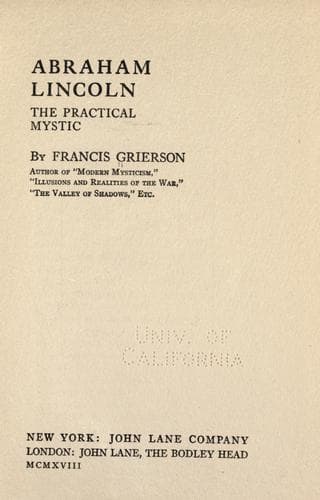
Abraham Lincoln: The Practical Mystic — John Shaqi
Abraham Lincoln: The Practical MysticGrierson, Francis
Religion
Abraham Lincoln: The Practical Mystic
Grierson, Francis
Lincoln, Abraham, 1809-1865 -- Psychology
"'I see right away the difference a-twixt Lincoln en Douglas warn't so
much in Lincoln bein' a good ways over six foot en Douglas a good ways
under, ez it war in their eyes. The Jedge looked like he war speakin'
agin time, but Abe Lincoln looked plumb through the meetin' into the
everlastin'--the way Moses must hev looked when he see Canaan ahead--en
I kin tell ye I never did see a man look that a-way.'"
_The Great Debate_
The hour had struck for the supreme test between the forces of slavery,
on one hand, and the forces of freedom, on the other. A vast throng
gathered at Alton from every section of the country to hear the last
public discussion between the two antagonists, Lincoln and Douglas, and
from the surging sea of faces thousands of anxious eyes gazed upward at
the group of politicians on the balcony like wrecked mariners scanning
the horizon for the smallest sign of a white sail of hope.
"This final debate resembled a duel between two men-of-war, the pick of
a great fleet, all but these two sunk or abandoned in other waters,
facing each other in the open, Douglas, the Little Giant, hurling at his
opponent from his flagship of slavery his deadliest missiles, Lincoln
calmly waiting to sink his antagonist by one single broadsider.
"Regarded in the light of spiritual reality, Lincoln and Douglas were
predestined to meet side by side in this discussion, and it is hardly
possible to give an adequate idea of the startling difference between
the two temperaments: Douglas--short, plump, and petulant;
Lincoln--long, gaunt, and self-possessed; the one white-haired and
florid, the other black-haired and swarthy; the one educated and
polished, the other unlettered and primitive.
"Judge Douglas opened the debate in a sonorous voice plainly heard by
all, and with a look of mingled defiance and confidence he marshalled
his facts and deduced his arguments. To the vigour of his attack there
was added the prestige of the Senate Chamber, and it looked as if he
would carry the majority with him. When, after a brilliant oratorical
effort, he brought his speech to a close, it was amidst the shouts and
yells of thousands of admirers.
"And now, Abraham Lincoln, the man who in 1830 undertook to split for
Mrs. Nancy Miller four hundred rails for every yard of jean dyed with
walnut bark that would be required to make him a pair of trousers, the
flat-boatman, local stump-orator, and country lawyer, rose from his
seat, stretched his long bony limbs upward, as if to get them in working
order, and stood like some solitary pine on a lonely summit, very tall,
very dark, very gaunt, and very rugged, his swarthy features stamped
with a sad serenity, and the instant he began to speak the mouth lost
its heaviness, the eyes attained a wondrous illumination, and the people
stood bewildered and breathless under the natural magic of the most
original personality known to the English-speaking world since Robert
Burns.
Public-domain text, read in full here on John Shaqi.
Reviews
Reviews
No reviews yet
Be the first to share your thoughts on this work.
Join the Discussion
Join the discussion
Sign in to leave a comment or review.
Sign InorCreate an account