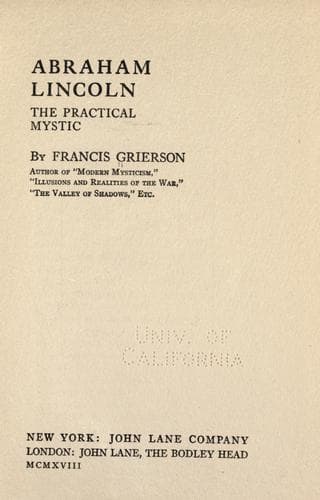
Abraham Lincoln: The Practical MysticGrierson, Francis
Religion
Abraham Lincoln: The Practical Mystic
Grierson, Francis
Lincoln, Abraham, 1809-1865 -- Psychology
"Mr. Lincoln saw philosophy in a story and a schoolmaster in a joke. No
man saw nature, fact, thing, from his standpoint. His was a new and
original position, which was always suggesting, hinting something to
him. Nature, insinuations, hints, and suggestions were new, fresh,
original, and odd to him. The world, fact, man, principle, all had their
powers of suggestion to his susceptible soul. They continually put him
in mind of something known or unknown. Hence his power and tenacity of
what is called association of ideas. His susceptibilities to all
suggestions and hints enabled him at will to call up readily the
associated and classified fact and idea.
"Mr. Lincoln was often at a loss for a word and hence was compelled to
resort to stories, and maxims, and jokes to embody his idea, that it
might be comprehended. So true was this peculiar mental vision of his,
that though mankind has been gathering, arranging, and classifying facts
for thousands of years, Lincoln's peculiar standpoint could give him no
advantage of other men's labour. Hence he tore up to the deep
foundations all arrangements of facts, and coined and arranged new plans
to govern himself. His labour was great, continuous, patient, and
all-enduring.
_The Great Books_
"The truth about the whole matter is that Mr. Lincoln read _less_ and
thought _more_ than any man in his sphere in America. When young he read
the Bible, and when of age he read Shakespeare. The latter book was
scarcely ever out of his mind. Mr. Lincoln is acknowledged to have been
a great man, but the question is, what made him great? I repeat, that he
read less and thought more than any man of his standing in America, if
not in the world. He possessed originality and power of thought in an
eminent degree. He was cautious, cool, patient, and enduring. These are
some of the grounds of his wonderful success. Not only was nature, man,
fact, and principle suggestive to Mr. Lincoln, not only had he accurate
and exact perceptions, but he was causative, i. e., his mind ran back
behind all facts, things, and principles to their origin, history, and
first cause--to that point where forces act at once as effect and cause.
He would stop and pause in the street and analyse a machine. He would
whittle things to a point and then count the numberless inclined planes,
and their pitch, making the point. Mastering and defining this, he would
then cut that point back, and get a broad transverse section of his pine
stick, and peel and define that. Clocks, omnibuses, language,
paddle-wheels, and idioms never escaped his observation and analysis.
Before he could form any idea of anything, before he would express his
opinion on any subject, he must know its origin and history, in
substance and quality, in magnitude and gravity. He must know his
subject inside and outside, upside and downside.
Public-domain text, read in full here on John Shaqi.
Reviews
Reviews
No reviews yet
Be the first to share your thoughts on this work.
Join the Discussion
Join the discussion
Sign in to leave a comment or review.
Sign InorCreate an account