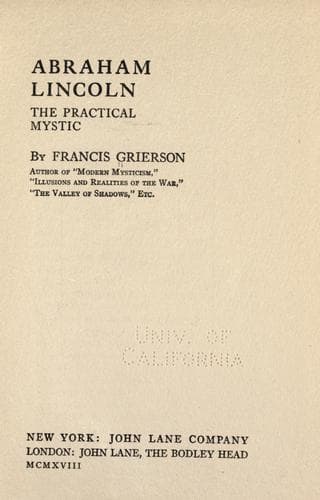
Abraham Lincoln: The Practical MysticGrierson, Francis
Religion
Abraham Lincoln: The Practical Mystic
Grierson, Francis
Lincoln, Abraham, 1809-1865 -- Psychology
"One day, at Washington, he made this remark to me: 'If ever this free
people, if this Government itself is ever utterly demoralised, it will
come from this human wriggle and struggle for office--a way to live
without work.'
"It puzzled him at Washington to know and to get at the root of this
dread desire, this contagious disease of national robbery in the
nation's death-struggle.
"This man, this long, bony, wiry, sad man, floated into our country in
1831, in a frail canoe, down the north fork of the Sangamon River,
friendless, penniless, powerless, and alone--begging for work in our
city--ragged, struggling for the common necessities of life. This man,
this peculiar man, left us in 1861, the President of the United States,
backed by friends, power, fame, and all human force."
_Lincoln's Energy and Will_
Energy is usually a blind force in the conduct of human affairs and the
greatest with which we have to deal. History is made up of the deeds of
individuals with a surplus of energy, which overflows and damages
governments as floods damage lands.
Will, energy, and ambition are, in most cases, synonymous terms. Without
energy the will breaks down, and without ambition energy and will would
prove innocuous. No one can doubt that misdirected energy was at the
bottom of much that moved the Prussians and that their ambitions were
wholly material, limited to geographical boundaries. Lincoln displayed
physical as well as mental energy in a supernormal degree; his will was
as fixed as a mountain of adamant, while his ambition was not personal,
but national and universal. Only the practical mystic could direct such
forces with wisdom, and as we look still closer into the mystery of his
temperament the question of pride and vanity arises, and their relation
to ambition and will.
In the first place, what causes ambition? Pride, answers the world. But
the world is wrong. Ambition is not the result of pride but of vanity.
Solomon, the wisest and greatest man of his time, was a proud man and a
wise ruler until he began to import apes and peacocks. Then vanity
usurped the place of pride and he came to the end of his temporal
tether.
Public-domain text, read in full here on John Shaqi.
Reviews
Reviews
No reviews yet
Be the first to share your thoughts on this work.
Join the Discussion
Join the discussion
Sign in to leave a comment or review.
Sign InorCreate an account