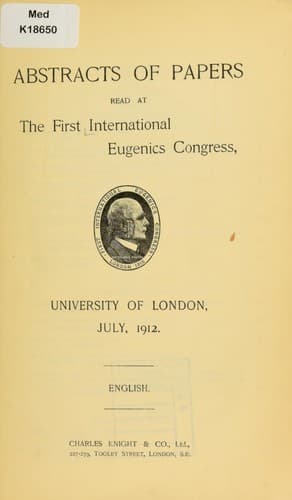
Abstracts of Papers Read at the First International Eugenics Congress: University of London, July, 1912International Eugenics Congress (1st : 1912 : London)
Science
Abstracts of Papers Read at the First International Eugenics Congress: University of London, July, 1912
International Eugenics Congress (1st : 1912 : London)
Eugenics -- Congresses
_Professor of Anthropology, Naples._
The Mendelian laws find verification in man. Every race, whether a
sub-species or a variety, has an hereditary possession of certain
characters; a possession which is completely transmitted to the
descendants, in whom is preserved the same germ plasm as in the
progenitors.
The researches of C. B. and G. Davenport seem to have proved the
recessive character of albinism and its obedience to the Mendelian
law. Hurst has presented figures which show that the inheritance of
colour in the iris of the human eye obeys Mendelian laws. Davenport
has established the order of dominance by the form of hair, which also
obeys the Mendelian law.
De Quatrefages, many years before the re-affirmation of Mendel's
discoveries, wrote:--
"The union of individuals of different races involves a contest
between their two natures--a contest of which the theatre is the
field where the new being is organised. Now, this contest does not
take place _en bloc_, so to speak, as has been generally admitted.
Each of the characters of the two parents struggles on its own account
against the corresponding character (its antagonist, as has just
been said). When the hereditary energy is equal on both sides there
necessarily ensues a kind of process of which the consequence is the
fusion of the maternal and paternal characters in an intermediate
character. If the energies are very unequal the hybrid inherits a
character borrowed entirely from one of his parents; but this parent,
conqueror on one point, may be conquered upon another. Hence, there
results with the hybrid a _juxtaposition_ of characters derived from
each of the types of which he is the child."
Above all, I have wished to call attention to the so-called laws of
dominance, because of their great importance. We may conclude that in
the case of man the dominant characters are also the original ones.
THE INHERITANCE OF FECUNDITY.
(Abstract.)
By Raymond Pearl,
_Biologist, Maine Agricultural Experiment Station._
The purpose of this paper is to give an account (necessarily
abbreviated, and without presentation of complete evidence) of the
results of an investigation into the mode of inheritance of fecundity
in the domestic fowl, and to point out some of the possible eugenic
bearings of these results.
It is shown that while the continued selection, over a period of years,
of highly fecund females failed to bring about any change in average
fecundity of the strain used, this character must nevertheless be
inherited since pedigree lines have been isolated which uniformly breed
true to definite degrees of fecundity.
It is further shown that observed variations in actually realized
fecundity (number of eggs laid) do not depend upon anatomical
differences in respect to the number of visible oöcytes in the ovary.
The differential factor on which the variations in fecundity depend
must be primarily physiological.
Public-domain text, read in full here on John Shaqi.
Reviews
Reviews
No reviews yet
Be the first to share your thoughts on this work.
Join the Discussion
Join the discussion
Sign in to leave a comment or review.
Sign InorCreate an account