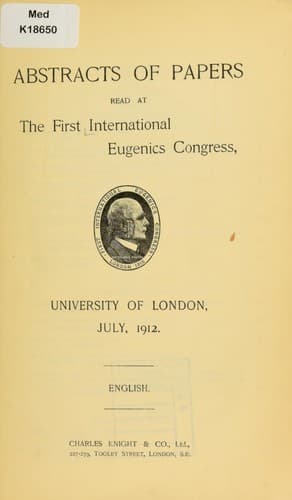
Abstracts of Papers Read at the First International Eugenics Congress: University of London, July, 1912International Eugenics Congress (1st : 1912 : London)
Science
Abstracts of Papers Read at the First International Eugenics Congress: University of London, July, 1912
International Eugenics Congress (1st : 1912 : London)
Eugenics -- Congresses
The science of eugenics should not look for the realisation of a
uniform type of man, but vary its aims and methods according to the
natural differentiation of races and nations, taking account of ethnic
psychology equally with ethnic somatology.
The humanity of the future will be physically and mentally superior
to the existing humanity, but the _amelioration of the species_ ought
not to aim at the equality of races and populations. These races
and populations ought not to lose their acquisition of particular
adaptations to different conditions of existence.
A science of universal or common eugenics should allow a eugenic
ethnology to exist, which should indicate and facilitate for each race
or nation the defence and propagation of its own _physical type_ and
its own _mentality_. The most vigorous and dominant races will always
be those which know how to create and preserve in sexual unions their
characteristics of structure and culture.
THE INHERITANCE OF EPILEPSY.
(Abstract.)
By David Fairchild Weeks, M.D.,
_Medical Superintendent and Executive Officer, the New Jersey State
Village for Epileptics at Skillman, U.S.A._
In this paper the writer has endeavoured to learn what laws, if
any, epilepsy follows in its return to successive generations, and
the relation it bears to alcoholism, migraine, paralysis, and other
symptoms of lack of neural strength.
The data used in the study was analysed according to the Mendelian
method which assumes that the inheritance of any character is not
from the parents, grandparents, etc., but from the germ plasm out
of which every fraternity and its parents and other relatives have
arisen. If the soma possesses the trait of the recessive to normality
sort, it lacks in its germ plasm the determiner upon which the normal
development depends, and this condition is called nulliplex. If the
soma possesses the trait of the dominant to normality sort, the
determiner was derived from both parents and is double in the germ
plasm, or normal, all of the germ cells have the determiner; or else it
came from one parent only, is single in the germ plasm, or simplex,
and half of the germ cells have and half lack the determiner.
The method of obtaining the data was by means of field workers, who
interviewed in their homes the parents, relatives and all others
interested in the epileptic patient. These visits have established
a friendly feeling toward and an intelligent understanding of the
Institution and its work.
The study is based on the data derived from 397 histories, covering 440
matings.
The matings are classified under the six possible types, of nulliplex ×
nulliplex, nulliplex × simplex, nulliplex × normal, simplex × simplex,
simplex × normal, and normal × normal.
Public-domain text, read in full here on John Shaqi.
Reviews
Reviews
No reviews yet
Be the first to share your thoughts on this work.
Join the Discussion
Join the discussion
Sign in to leave a comment or review.
Sign InorCreate an account