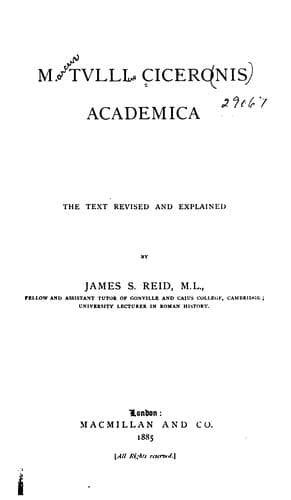
Knowledge, Theory of -- Early works to 1800; Philosophy -- Early works to 1800
58, _Laelius_ 20, 47, _T.D._ I. 64.
§8. _Id est ... jubeo_: these words have been naturally supposed a gloss.
But Cicero is nothing if not tautological; he is fond of placing slight
variations in phrase side by side. See some remarkable instances of
slightly varied phrases connected by _id est_ in _D.F._ I. 72, II. 6, 90. I
therefore hold Halm and Baiter to be wrong in bracketing the words. _Ea a_:
Lamb., objecting to the sound (which is indeed not like Cic.), would read
_e_ for _a_, which Halm would also prefer. _De_, _ab_, and _ex_ follow
_haurire_ indifferently in Cic. _Rivulos consectentur_: so Wordsworth, "to
hunt the waterfalls". The metaphor involved in _fontibus--rivulos_ is often
applied by Cic. to philosophy, see esp. a sarcastic passage about Epicurus
in _N.D._ I. 120. _Nihil enim magno opere_: _magno opere_ should be written
in two words, not as _magnopere_, cf. the phrases _maximo opere_, _nimio
opere_, the same holds good of _tanto opere_, _quanto opere_. _L. Aelii_:
MSS. _Laelii_. The person meant is L. Aelius Stilo or Praeconinus, the
master of Varro, and the earliest systematic grammarian of Rome. See
Quintil. _Inst. Or._ X. 1, 99, Gellius X. 21, Sueton. _Gramm._ 3.
_Occasum_: an unusual metaphor. _Menippum_: a Cynic satirist, see _Dict.
Biogr._ Considerable fragments of Varro's Menippean Satires remain, and
have often been edited--most recently by Riese (published by Teubner).
_Imitati non interpretati_: Cic. _D.F._ I. 7, gives his opinion as to the
right use to be made of Greek models. _†Quae quo_: these words are
evidently wrong. Halm after Faber ejects _quae_, and is followed by Baiter.
Varro is thus made to say that he stated many things dialectically, _in
order that_ the populace might be enticed to read. To my mind the fault
lies in the word _quo_, for which I should prefer to read _cum_ (=_quom_,
which would be written _quō_ in the MSS.) The general sense would then be
"Having introduced philosophy into that kind of literature which the
unlearned read, I proceeded to introduce it into that which the learned
read." _Laudationibus_: λογοις επιταφιοις, cf. _Ad Att._ XIII. 48 where
Varro's are mentioned. _†Philosophe scribere_: the MSS. all give
_philosophie_. Klotz has _philosophiam_, which is demonstrably wrong,
_physica_, _musica_ etc. _scribere_ may be said, but not _physicam_,
_musicam_ etc. _scribere_. The one passage formerly quoted to justify the
phrase _philosophiam scribere_ is now altered in the best texts (_T.D._ V.
121, where see Tischer). Goer. reads _philosophiae scribere_; his
explanation is, as Orelli gently says, "vix Latina." I can scarcely think
Halm's _philosophe_ to be right, the word occurs nowhere else, and Cic.
almost condemns it by his use of the Greek φιλοσοφως (_Ad Att._ XIII. 20).
In older Greek the adverb does not appear, nor is φιλοσοφος used as an
adjective much, yet Cic. uses _philosophus_ adjectivally in _T.D._ V. 121,
_Cat. Mai._ 22, _N.D._ III.
Public-domain text, read in full here on John Shaqi.
Reviews
Reviews
No reviews yet
Be the first to share your thoughts on this work.
Elsewhere in the archive
Join the Discussion
Join the discussion
Sign in to leave a comment or review.
Sign InorCreate an account