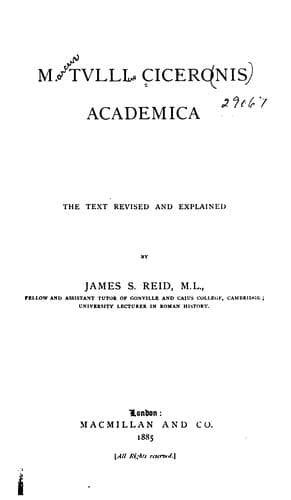
Knowledge, Theory of -- Early works to 1800; Philosophy -- Early works to 1800
§7. _Sive sequare ... magnum est_: for the constr. cf. II. 140. _Magnum
est_: cf. _quid est magnum_, 6. _Verum et simplex bonum_: cf. 35. _Quod
bonum ... ne suspicari quidem_ an opinion often denounced by Cic., see esp
_T.D._ III. 41, where Cic.'s Latin agrees very closely with the Greek
preserved by Diog. Laert. X. 6 (qu. Zeller, 451), and less accurately by
Athenaeus, VII. 279 (qu. R. and P. 353). _Ne suspicari quidem_: for this
MSS. give _nec suspicari_, but Madv. (_D.F._, Excursus III.) has
conclusively shown that _nec_ for _ne ... quidem_ is post Augustan Latin.
Christ supposes some thing like _sentire_ to have fallen out before _nec
suspicari_; that this is wrong is clear from the fact that in _D.F._ II.
20, 30, _T.D._ III. 46, _N.D._ I. 111, where the same opinion of Epicurus
is dealt with, we have either _ne suspicari quidem_ or _ne intellegere
quidem_ (cf. also _In Pisonem_ 69). Further, _ne ... quidem_ is esp
frequent with _suspicari_ (_D.F._ II. 20), and verbs of the kind
(_cogitari_ II. 82), and especially, as Durand remarked, at the end of
sentences eg _Verr._ II. 1, 155. Notice _negat ... ne suspicari quidem_
without _se_, which however Baiter inserts, in spite of the numerous
passages produced from Cic. by Madv. (_Em._ 111), in which not only _se_,
but _me_, _nos_, and other accusatives of pronouns are omitted before the
infinitive, after verbs like _negat_. Cf. also the omission of _sibi_ in
_Paradoxa_ 40. _Si vero_: this, following _sive enim_ above, is a departure
from Cic.'s rule which is to write _sive--sive_ or _si--sin_, but not
_si--sive_ or _sive--si_. This and two or three other similar passages in
Cic. are explained as anacolutha by Madv. in a most important and
exhaustive excursus to his _D.F._ (p. 785, ed. 2), and are connected with
other instances of broken sequence. There is no need therefore to read
_sive_ here, as did Turn. Lamb. Dav. and others. _Quam nos ... probamus_:
cf. Introd. p. 62. _Erit explicanda_: for the separation of these words by
other words interposed, which is characteristic of Cic., see 11, 17. I am
surprised that Halm and Baiter both follow Ernesti in his hypercritical
objection to the phrase _explicare Academiam_, and read _erunt_ against the
MSS., making _illa_ plural. If _erunt_ is read, _erit_ must be supplied
from it to go with _disserendum_, which is harsh. _Quam argute, quam
obscure_: at first sight an oxymoron, but _argute_ need not only imply
_clearness_, it means merely "acutely". _Quantum possum_: some MSS. have
_quantam_, which is scarcely Latin, since in Cic. an accusative only
follows _nequeo_, _volo_, _malo_, _possum_, and such verbs when an
infinitive can be readily supplied to govern it. For _velle_ see a good
instance in _D.F._ III. 68, where consult Madv. _Constantiam_: the notions
of firmness, consistency, and clearness of mind are bound up in this word,
cf. II. 53. _Apud Platonem_: _Timaeus_, 47 B, often quoted or imitated by
Cic., cf. _De Leg._ I.
Public-domain text, read in full here on John Shaqi.
Reviews
Reviews
No reviews yet
Be the first to share your thoughts on this work.
Elsewhere in the archive
Join the Discussion
Join the discussion
Sign in to leave a comment or review.
Sign InorCreate an account