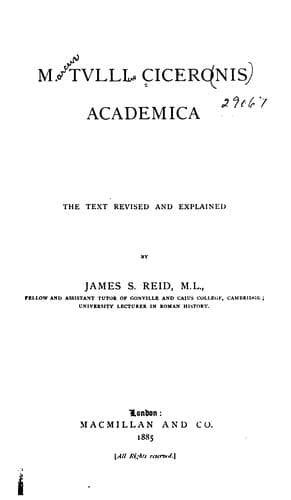
Knowledge, Theory of -- Early works to 1800; Philosophy -- Early works to 1800
§19. _Ratio triplex_: Plato has not this division, either consciously or
unconsciously, though it was generally attributed to him in Cicero's time,
so by Varro himself (from Antiochus) in Aug. _De Civ. Dei_ VIII. 4, and by
Diog. Laert. III. 56 (see R. and P., p. 195). The division itself cannot be
traced farther back than Xenocrates and the post-Aristotelian Peripatetics,
to whom it is assigned by Sext. Emp. _Adv. Math._ VII. 16. It was probably
first brought into strong prominence by the Stoics, whom it enabled more
sharply and decisively to subordinate to Ethics all else in philosophy. Cf.
esp. _M.D.F._ IV. 3. _Quid verum ... repugnans iudicando_: MSS. exc. G have
_et_ before _quid falsum_, whence Klotz conj. _sit_ in order to obviate the
awkwardness of _repugnet_ which MSS. have for _repugnans_. Krische wishes
to read _consequens_ for _consentiens_, comparing _Orator_ 115, _T.D._ V.
68, _De Div._ II. 150, to which add _T.D._ V. 21 On the other hand cf. II.
22, 91. Notice the double translations of the Greek terms, _de vita et
moribus_ for ηθικη, etc. This is very characteristic of Cic., as we shall
see later. _Ac primum_: many MSS. and edd. _primam_, cf. 23, 30. _A natura
petebant_: how Antiochus could have found this in Plato and Aristotle is
difficult to see; that he did so, however, is indubitable; see _D.F._ V.
24--27, which should be closely compared with our passage, and Varro in
Aug. XIX. 3. The root of Plato's system is the ιδεα of the Good, while so
far is Aristotle from founding his system on the abstract φυσις, that he
scarcely appeals even incidentally to φυσις in his ethical works. The
abstract conception of nature in relation to ethics is first strongly
apparent in Polemo, from whom it passed into Stoic hands and then into
those of Antiochus. _Adeptum esse omnia_: put rather differently in _D.F._
V. 24, 26, cf. also _D.F._ II. 33, 34, _Ac._ II. 131. _Et animo et corpore
et vita_: this is the τριας or τριλογια των αγαθων, which belongs in this
form to late Peripateticism (cf. _M.D.F._ III. 43), the third division is a
development from the βιος τελειος of Aristotle. The τριας in this distinct
shape is foreign both to Plato and Arist, though Stobaeus, _Ethica_ II. 6,
4, tries hard to point it out in Plato; Varro seems to merge the two last
divisions into one in Aug. _De Civ. Dei_ XIX 3. This agrees better with
_D.F._ V. 34--36, cf. also Aug. VIII. 8. On the Antiochean _finis_ see more
in note on 22. _Corporis alia_: for ellipse of _bona_, see n. on 13.
_Ponebant esse_: n. on 36. _In toto in partibus_: the same distinction is
in Stob. _Eth._ II. 6, 7; cf. also _D.F._ V. 35. _Pulchritudinem_: Cic.
_Orator_ 160, puts the spelling _pulcher_ beyond a doubt; it often appears
in inscr. of the Republic. On the other hand only _pulcrai_, _pulcrum_,
etc., occur in inscr., exc. _pulchre_, which is found once (_Corp. Inscr._
I. no 1019). _Sepulchrum_, however, is frequent at an early time. On the
Public-domain text, read in full here on John Shaqi.
Reviews
Reviews
No reviews yet
Be the first to share your thoughts on this work.
Elsewhere in the archive
Join the Discussion
Join the discussion
Sign in to leave a comment or review.
Sign InorCreate an account