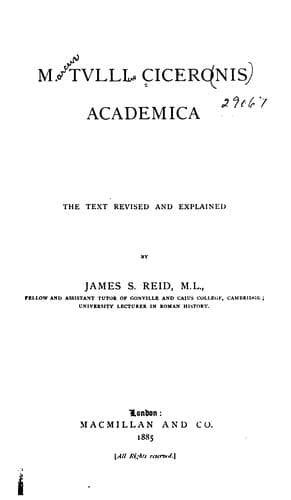
Knowledge, Theory of -- Early works to 1800; Philosophy -- Early works to 1800
intervalla ... possint_: there is no ultimate space atom, just as there is
no matter atom. As regards space, the Stoics and Antiochus closely followed
Aristotle, whose ideas may be gathered from R. and P. 288, 9, and
especially from M. Saint Hilaire's explanation of the _Physica_.
§28. _Ultro citroque_: this is the common reading, but I doubt its
correctness. MSS. have _ultro introque_, whence _ed. Rom._ (1471) has
_ultro in utroque_. I think that _in utroque_, simply, was the reading, and
that _ultro_ is a dittographia from _utro_. The meaning would be "since
force plays this part in the compound," _utroque_ being as in 24 for _eo
quod ex utroque fit_. If the vulg. is kept, translate "since force has this
motion and is ever thus on the move." _Ultro citroque_ is an odd expression
to apply to universal Force, Cic. would have qualified it with a _quasi_.
Indeed if it is kept I suggest _quasi_ for _cum sic_. The use of _versetur_
is also strange. _E quibus in omni natura_: most edd. since Dav. (Halm
included) eject _in_. It is perfectly sound if _natura_ be taken as ουσια =
existence substance. The meaning is "out of which _qualia_, themselves
existing in (being co-extensive with) universal substance (cf. _totam
commutari_ above), which is coherent and continuous, the world was formed."
For the _in_ cf. _N.D._ II. 35, _in omni natura necesse est absolvi
aliquid_, also a similar use _ib._ II. 80, and _Ac._ II. 42. If _in
utroque_ be read above, _in omni natura_ will form an exact contrast,
substance as a whole being opposed to the individual _quale_. _Cohaerente
et continuata_: the Stoics made the universe much more of a unity than any
other school, the expressions here and the striking parallels in _N.D._ II.
19, 84, 119, _De Div._ II. 33, _De Leg._ fragm. 1. (at the end of Bait. and
Halm's ed.) all come ultimately from Stoic sources, even if they be got at
second hand through Antiochus. Cf. Zeller 137, Stob. I. 22, 3. The _partes
mundi_ are spoken of in most of the passages just quoted, also in _N.D._
II. 22, 28, 30, 32, 75, 86, 115, 116, all from Stoic sources. _Effectum
esse mundum_: Halm adds _unum_ from his favourite MS. (G). _Natura
sentiente_: a clumsy trans. of αισθητη ουσια = substance which can affect
the senses. The same expression is in _N.D._ II. 75. It should not be
forgotten, however, that to the Stoics the universe was itself sentient,
cf. _N.D._ II. 22, 47, 87. _Teneantur_: for _contineantur_; cf. _N.D._ II.
29 with II. 31 _In qua ratio perfecta insit_: this is thorough going
Stoicism. Reason, God, Matter, Universe, are interchangeable terms with the
Stoics. See Zeller 145--150 By an inevitable inconsistency, while believing
that Reason _is_ the Universe, they sometimes speak of it as being _in_ the
Universe, as here (cf. Diog. Laert. VII. 138, _N.D._ II. 34) In a curious
passage (_N.D._ I. 33), Cic. charges Aristotle with the same inconsistency.
For the Pantheistic idea cf. Pope "lives through all life, extends through
Public-domain text, read in full here on John Shaqi.
Reviews
Reviews
No reviews yet
Be the first to share your thoughts on this work.
Elsewhere in the archive
Join the Discussion
Join the discussion
Sign in to leave a comment or review.
Sign InorCreate an account