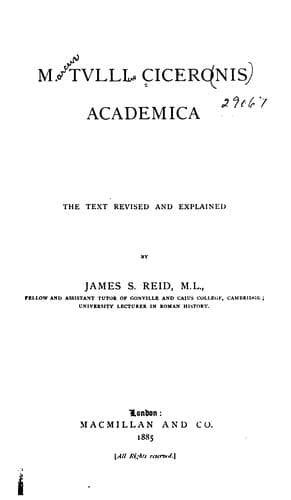
Knowledge, Theory of -- Early works to 1800; Philosophy -- Early works to 1800
all extent". _Sempiterna_: Aristotle held this: see II. 119 and _N.D._ II.
118, Stob. I. 21, 6. The Stoics while believing that our world would be
destroyed by fire (Diog. Laert. VII. 141, R. and P. 378, Stob. I. 20, 1)
regarded the destruction as merely an absorption into the Universal World
God, who will recreate the world out of himself, since he is beyond the
reach of harm (Diog. Laert. VII. 147, R. and P. 386, Zeller 159) Some
Stoics however denied the εκπυρωσις. _Nihil enim valentius_: this is an
argument often urged, as in _N.D._ II. 31 (_quid potest esse mundo
valentius?_), Boethus quoted in Zeller 159. _A quo intereat_: _interire_
here replaces the passive of _perdere_ cf. αναστηναι, εκπιπτειν ‛υπο τινος.
§29. _Quam vim animum_: there is no need to read _animam_, as some edd. do.
The Stoics give their World God, according to his different attributes, the
names God, Soul, Reason, Providence, Fate, Fortune, Universal Substance,
Fire, Ether, All pervading Air-Current, etc. See Zeller, ch. VI. _passim_.
Nearly all these names occur in _N.D._ II. The whole of this section is
undilutedly Stoic, one can only marvel how Antiochus contrived to fit it
all in with the known opinions of old Academics and Peripatetics.
_Sapientiam_: cf. _N.D._ II. 36 with III. 23, in which latter passage the
Stoic opinion is severely criticised. _Deum_: Cic. in _N.D._ I. 30 remarks
that Plato in his _Timaeus_ had already made the _mundus_ a God. _Quasi
prudentium quandam_: the Greek προνοια is translated both by _prudentia_
and _providentia_ in the same passage, _N.D._ II. 58, also in _N.D._ II.
77--80. _Procurantem ... quae pertinent ad homines_: the World God is
perfectly beneficent, see _Ac._ II. 120, _N.D._ I. 23, II. 160 (where there
is a quaint jest on the subject), Zeller 167 sq. _Necessitatem_: αναγκην,
which is ειρμος αιτιων, _causarum series sempiterna_ (_De Fato_ 20, cf.
_N.D._ I. 55, _De Div._ I. 125, 127, Diog. VII. 149, and Zeller as before).
This is merely the World God apprehended as regulating the orderly sequence
of cause upon cause. When the World God is called Fortune, all that is
expressed is human inability to see this orderly sequence. Τυχη therefore
is defined as αιτια αδηλος ανθρωπινωι λογισμωι (Stob. I. 7, 9, where the
same definition is ascribed to Anaxagoras--see also _Topica_, 58--66). This
identification of Fate with Fortune (which sadly puzzles Faber and excites
his wrath) seems to have first been brought prominently forward by
Heraclitus, if we may trust Stob. I. 5, 15. _Nihil aliter possit_: on
_posse_ for _posse fieri_ see _M.D.F._ IV. 48, also _Ac._ II. 121. For the
sense of Cleanthes' hymn to Zeus (i.e. the Stoic World-God), ουδε τι
γιγνεται εργον επι χθονι σου διχα δαιμον. _Inter quasi fatalem_: a trans.
of the Gk. κατηναγκασμενον. I see no reason for suspecting _inter_, as Halm
does. _Ignorationemque causarum_: the same words in _De Div._ II. 49; cf.
also August. _Contra Academicos_ I. 1. In addition to studying the reff.
Public-domain text, read in full here on John Shaqi.
Reviews
Reviews
No reviews yet
Be the first to share your thoughts on this work.
Elsewhere in the archive
Join the Discussion
Join the discussion
Sign in to leave a comment or review.
Sign InorCreate an account