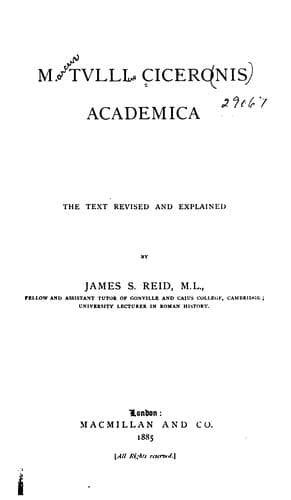
Knowledge, Theory of -- Early works to 1800; Philosophy -- Early works to 1800
One more remark, and I conclude this wearisome note. The
_quasi_ marks _rerum nota_ as an unfamiliar trans. of συμβολον. Davies
therefore ought not to have placed it before _ducibus_, which word, strong
as the metaphor is, requires no qualification, see a good instance in
_T.D._ I. 27. _Itaque tradebatur_: so Halm improves on Madvig's _ita_ for
_in qua_ of the MSS., which cannot be defended. Orelli's reference to 30
_pars_ for an antecedent to _qua_ (_in ea parte in qua_) is violent, while
Goerenz's resort to _partem rerum opinabilem_ is simply silly. Manut. conj.
_in quo_, Cic. does often use the neut. pronoun, as in _Orator_ 3, but not
quite thus. I have sometimes thought that Cic. wrote _haec, inquam_ (cf.
_huic_ below). _Dialecticae_: as λογικη had not been Latinised, Cic. is
obliged to use this word to denote λογικη, of which διαλεκτικη is really
one subdivision with the Stoics and Antiochus, ‛ρητορικη which is mentioned
in the next sentence being the other; see Zeller 69, 70. _Orationis ratione
conclusae_: speech drawn up in a syllogistic form which becomes _oratio
perpetua_ under the influence of ‛ρητορικη. _Quasi ex altera parte_: a
trans. of Aristotle's αντιστροφος in the beginning of the _Rhetoric_.
_Oratoria_: Halm brackets this word; cf. however a close parallel in
_Brut._ 261 _oratorio ornamenta dicendi_. The construction is simply a
variation of Cic.'s favourite double genitive (_T.D._ III. 39), _oratoria_
being put for _oratoris_. _Ad persuadendum_: το πιθανον is with Arist. and
all ancient authorities the one aim of ‛ρητορικη.
Public-domain text, read in full here on John Shaqi.
Reviews
Reviews
No reviews yet
Be the first to share your thoughts on this work.
Elsewhere in the archive
Join the Discussion
Join the discussion
Sign in to leave a comment or review.
Sign InorCreate an account