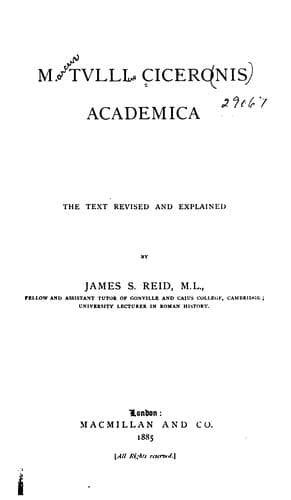
Knowledge, Theory of -- Early works to 1800; Philosophy -- Early works to 1800
§§33--42. Part v. of Varro's exposition: the departures from the old
Academico-Peripatetic school. Summary. Arist. crushed the ιδεαι of
Plato, Theophrastus weakened the power of virtue (33). Strato abandoned
ethics for physics, Speusippus, Xenocrates, Polemo, Crates, Crantor
faithfully kept the old tradition, to which Zeno and Arcesilas, pupils
of Polemo, were both disloyal (34). Zeno maintained that nothing but
virtue could influence happiness, and would allow the name _good_ to
nothing else (35). All other things he divided into three classes, some
were in accordance with nature, some at discord with nature, and some
were neutral. To the first class he assigned a positive value, and
called them _preferred_ to the second a negative value and called them
_rejected_, to the third no value whatever--mere verbal alterations on
the old scheme (36, 37). Though the terms _right action_ and _sin_
belong only to virtue and vice, he thought there was an appropriate
action (_officium_) and an inappropriate, which concerned things
_preferred_ and things _rejected_ (37). He made _all_ virtue reside in
the reason, and considered not the _practice_ but the mere _possession_
of virtue to be the important thing, although the possession could not
but lead to the practice (38). All emotion he regarded as unnatural and
immoral (38, 39). In physics he discarded the fifth element, and
believed fire to be the universal substance, while he would not allow
the existence of anything incorporeal (39). In dialectic he analysed
sensation into two parts, an impulse from without, and a succeeding
judgment of the mind, in passing which the will was entirely free (40).
Sensations (_visa_) he divided into the true and the untrue; if the
examination gone through by the mind proved irrefragably the truth of a
sensation he called it _Knowledge_, if otherwise, _Ignorance_ (41).
_Perception_, thus defined, he regarded as morally neither right nor
wrong but as the sole ultimate basis of truth. Rashness in giving
assent to phenomena, and all other defects in the application to them
of the reason he thought could not coexist with virtue and perfect
wisdom (42).
Public-domain text, read in full here on John Shaqi.
Reviews
Reviews
No reviews yet
Be the first to share your thoughts on this work.
Elsewhere in the archive
Join the Discussion
Join the discussion
Sign in to leave a comment or review.
Sign InorCreate an account