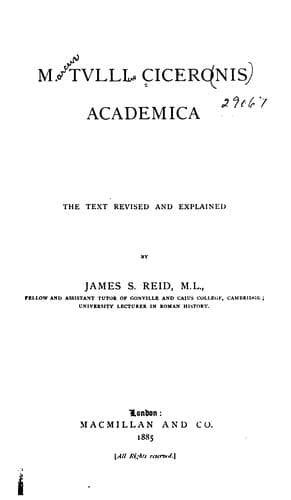
Knowledge, Theory of -- Early works to 1800; Philosophy -- Early works to 1800
§33. _Haec erat illis forma_: so Madv. _Em._ 118 for MSS. _prima_,
comparing _formulam_ in 17, also _D.F._ IV. 19, V. 9, _T.D._ III. 38, to
which add _Ac._ I. 23. See other em. in Halm. Goer. proposes to keep the
MSS. reading and supply _pars_, as usual. His power of _supplying_ is
unlimited. There is a curious similarity between the difficulties involved
in the MSS. readings in 6, 15, 32 and here. _Immutationes_: so Dav. for
_disputationes_, approved by Madv. _Em._ 119 who remarks that the phrase
_disputationes philosophiae_ would not be Latin. The em. is rendered almost
certain by _mutavit_ in 40, _commutatio_ in 42, and _De Leg._ I. 38. Halm's
odd em. _dissupationes_, so much admired by his reviewer in Schneidewin's
_Philologus_, needs support, which it certainly does not receive from the
one passage Halm quotes, _De Or._ III. 207. _Et recte_: for the _et_ cf.
_et merito_, which begins one of Propertius' elegies. _Auctoritas_:
"system". _Inquit_: sc. Atticus of course. Goer., on account of the
omission of _igitur_ after Aristoteles, supposes Varro's speech to begin
here. To the objection that Varro (who in 8 says _nihil enim meorum magno
opere miror_) would not eulogise himself quite so unblushingly, Goer.
feebly replies that the eulogy is meant for Antiochus, whom Varro is
copying. _Aristoteles_: after this the copyist of Halm's G. alone, and
evidently on his own conjecture, inserts _igitur_, which H. adopts. Varro's
resumption of his exposition is certainly abrupt, but if chapter IX. ought
to begin here, as Halm supposes, a reader would not be much incommoded.
_Labefactavit_, that Antiochus still continued to include Aristotle in the
supposed old Academico-Peripatetic school can only be explained by the fact
that he considered ethical resemblances as of supreme importance, cf. the
strong statement of Varro in Aug. XIX. 1 _nulla est causa philosophandi
nisi finis boni_. _Divinum_: see R. and P. 210 for a full examination of
the relation in which Plato's ιδεαι stand to his notion of the deity.
_Suavis_: his constant epithet, see Gellius qu. R. and P. 327. His real
name was not Theophrastus, he was called so from his style (cf. _loquendi
nitor ille divinus_, Quint. X. 1, 83). For _suavis_ of style cf. _Orat._
161, _Brut._ 120. _Negavit_: for his various offences see _D.F._ V. 12 sq.,
_T.D._ V. 25, 85. There is no reason to suppose that he departed very
widely from the Aristotelian ethics; we have here a Stoic view of him
transmitted through Antiochus. In II. 134 Cic. speaks very differently of
him. Between the particular tenet here mentioned and that of Antiochus in
22 the difference is merely verbal. _Beate vivere_: the only translation of
ευδαιμονιαν. Cic. _N.D._ I. 95 suggests _beatitas_ and _beatitudo_ but does
not elsewhere employ them.
Public-domain text, read in full here on John Shaqi.
Reviews
Reviews
No reviews yet
Be the first to share your thoughts on this work.
Elsewhere in the archive
Join the Discussion
Join the discussion
Sign in to leave a comment or review.
Sign InorCreate an account