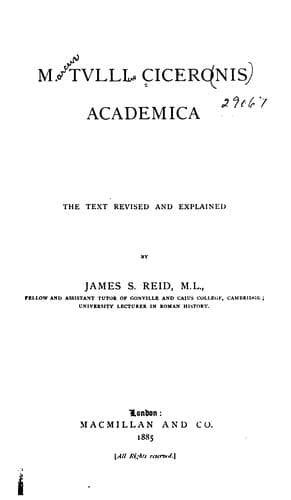
Knowledge, Theory of -- Early works to 1800; Philosophy -- Early works to 1800
ablative of the instrument. _Mandare monum._: cf. I. 3. _Insculptas_: rare
in the metaphorical use, cf. _N.D._ I. 45.
§3. _Genere_: "department" cf. I. 3. _Navalibus pugnis_: ναυμαχιαις.
_Instrumento et adparatu_: κατασκευη και παρασκευη. _Rex_: Mithridates.
_Quos legisset_: = _de quibus l._; cf. the use of the passive verb so
common in Ovid, e.g. _Trist._ IV. 4, 14. I take of course _rex_ to be nom.
to _legisset_, the suggestion of a friend that Lucullus is nom. and that
_quos legisset_ = _quorum commentarios legisset_ I think improbable.
_Hodie_: Drakenborch on Livy V. 27 wants to read _hodieque_, which however,
is not Ciceronian. In passages like _De Or._ I. 103 and _Verr._ V. 64, the
_que_ connects clauses and does not modify _hodie_. On this subject see
Madv. _Opuscula_ I. 390. _Etsi_: _M.D.F._ V. 68, shows that in Cic. a
parenthetic clause with _etsi_ always has a common verb with its principal
clause; a rule not observed by the silver writers. The same holds of
_quamquam_, see n. on I. 5. _Calumnia_: properly a fraudulent use of
litigation, συκοφαντια. The chief enemy was the infamous Memmius who
prosecuted him. _In urbem_: until his triumph Luc. would remain outside the
city. _Profuisset_: this ought properly to be _profuerit_, but the
conditional _dicerem_ changes it. _Potius ... quam ... communicem_: n. on
23.
§4. _Sunt ... celebrata_: cf. I. 11, 17 for the collocation of the words.
_Externa ... interiora_: cf. _De Div._ II. 124 _sed haec quoque in promptu,
nunc interiora videamus_. _Pro quaestore_: for this Faber wrote _quaestor_,
arguing that as Luc. was Sulla's _quaestor_ and Sulla sent him to Egypt, he
could not be _pro quaestor_. But surely after the first year he would be
_pro quaestor_. Dav. reads _quaestor_ here and 11, saying "_veterem
lectionem iugulavit Faber_". _Ea memoria ... quam_: Bentl., Halm, Baiter
give _qua_, Halm refers to Bentl. on Hor. _Sat._ I. 6, 15. A passage like
ours is _D.F._ I. 29, _ista sis aequitate, quam ostendis_, where one MS.
has _qua_. Read Madvig's lucid note there. _De quibus audiebat_: Madv.
_Em._ 121 makes this equivalent to _de eis rebus de quibus_, the necessity
of which explanation, though approved by Halm, I fail to see. The form of
expression is very common in Cic., and the relative always refers to an
actually expressed antecedent, cf. e.g. _Cat. Mai._ 83. I take _quibus_ as
simply = _libris_.
Public-domain text, read in full here on John Shaqi.
Reviews
Reviews
No reviews yet
Be the first to share your thoughts on this work.
Elsewhere in the archive
Join the Discussion
Join the discussion
Sign in to leave a comment or review.
Sign InorCreate an account