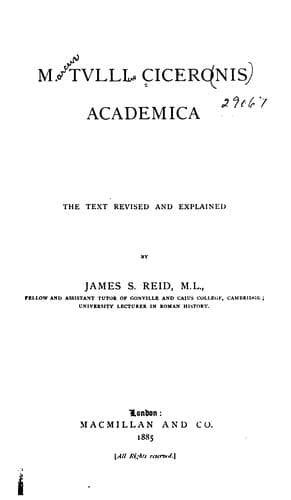
Knowledge, Theory of -- Early works to 1800; Philosophy -- Early works to 1800
§1. _Luculli_: see Introd. p. 58, and _Dict. Biog._ _Digna homini nobili_:
a good deal of learning would have been considered _unworthy_ of a man like
Lucullus, see Introd. p. 30. _Percepta_: "gained," "won;" cf. _percipere
fruges_, "to reap," _Cat. Mai._ 24. _Caruit_: "was cut off from;" _carere_
comes from a root _skar_ meaning to divide, see Corss. I. 403. For the
three nouns with a singular verb see Madv. _Gram._ 213 A, who confines the
usage to nouns denoting things and impersonal ideas. If the common reading
_dissensit_ in _De Or._ III. 68 is right, the restriction does not hold.
_Admodum_: "to a degree." _Fratre_: this brother was adopted by a M.
Terentius Varro, and was a man of distinction also; see _Dict. Biog._
_Magna cum gloria_: a ref. to _Dict. Biog._ will show that the whole affair
was discreditable to the father; to our notions, the sons would have gained
greater glory by letting it drop. _Quaestor_: to Sulla, who employed him
chiefly in the civil administration of Asia. _Continuo_: without any
interval. _Legis praemio_: this seems to mean "by the favour of a special
law," passed of course by Sulla, who had restored the old _lex annalis_ in
all its rigour, and yet excepted his own officers from its operation.
_Prooemio_, which has been proposed, would not be Latin, see _De Leg._ II.
16. _Consulatum_: he seems to have been absent during the years 84--74, in
the East. _Superiorum_: scarcely that of Sulla.
§2. _Laus_: "merit," as often, so _praemium_, Virg. _Aen._ XII. 437, means
a deed worthy of reward. _Non admodum exspectabatur_: Cic. forgets that
Luc. had served with distinction in the Social War and the first
Mithridatic war. _In Asia pace_: three good MSS. have _Asiae_; Baiter
ejects _Asia_; Guilelmus read _in Asia in pace_ (which Davies conjectures,
though he prints _Asiae_). _Consumere_ followed by an ablative without _in_
is excessively rare in Cic. Madv. _D.F._ V. 53 denies the use altogether.
In addition, however, to our passage, I note _hoc loco consumitur_ in
_T.D._ IV. 23, where Baiter's two texts (1861 and 1863) give no variants.
_Pace_ here perhaps ought to be taken adverbially, like _tranqullo_.
_Indocilem_: this is simply passive, = "untaught," as in Prop. I. 2, 12,
Ov. _Fast._ III. 119 (the last qu. by Dav.). Forc. s.v. is wrong in making
it active. _Factus_: = _perfectus_; cf. Hor. _Sat._ I. 5, 33 _homo factus
ad unguem_, Cic. _De Or._ III. 184, _In Verr._ IV. 126. So _effectus_ in
silver Latin. _Rebus gestis_: military history, so often. _Divinam quandam
memoriam_: the same phrase in _De Or._ II. 360. _Rerum, verborum_: same
distinction in _De Or._ II. 359. _Oblivisci se malle_: the same story is
told _D.F._ II. 104, _De Or._ II. 299. The ancient art of memory was begun
by Simonides (who is the person denoted here by _cuidam_) and completed by
Metrodorus of Scepsis, for whom see _De Or._ II. 360. _Consignamus_: cf.
_consignatae in animis notiones_ in _T.D._ I. 57. _litteris_ must be an
Public-domain text, read in full here on John Shaqi.
Reviews
Reviews
No reviews yet
Be the first to share your thoughts on this work.
Elsewhere in the archive
Join the Discussion
Join the discussion
Sign in to leave a comment or review.
Sign InorCreate an account