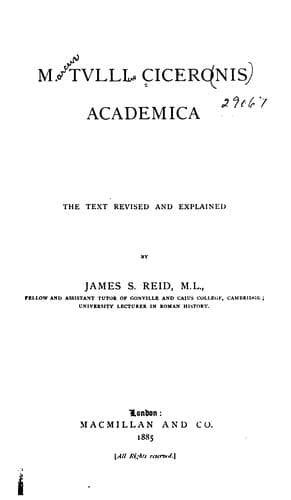
Knowledge, Theory of -- Early works to 1800; Philosophy -- Early works to 1800
§28. _Perceptum_: thoroughly known and grasped. Similar arguments are very
frequent in Sextus, e.g. _Adv. Math._ VIII. 281, where the dogmatist argues
that if proof be impossible, as the sceptic says, there must be a proof to
show it impossible; the sceptic doctrine must be _provable_. Cf. 109 of
this book. _Postulanti_: making it a necessity for the discussion; cf. _De
Leg._ I. 21. _Consentaneum esse_: ακολουθον ειναι. _Ut alia_: _although_
others. _Tantum abest ut--ut_: cf. Madv. _Gram._ 440 a.
§29. _Pressius_: cf. _De Fato_ 31, 33, _N.D._ II. 20, _T.D._ IV. 14,
_Hortensius_ fragm. 46 ed. Nobbe. The word is mocked in 109. _Decretum_: of
course the Academics would say they did not hold this δογμα as _stabile
fixum ratum_ but only as _probabile_. Sextus however _Pyrrh. Hyp._ I. 226
(and elsewhere) accuses them of making it in reality what in words they
professed it not to be, a fixed dogma. _Sentitis enim_: cf. _sentis_ in
_D.F._ III. 26. _Fluctuare_: "to be at sea," Halm _fluctuari_, but the
deponent verb is not elsewhere found in Cic. _Summa_: cf. _summa
philosophiae_ _D.F._ II. 86. _Veri falsi_: cf. n. on 92. _Quae visa_: so
Halm for MSS. _quaevis_, which edd. had changed to _quae a quovis_.
_Repudiari_: the selection depended on the _probabile_ of course, with the
Academics. _Veri falsique_: these words were used in different senses by
the dogmatist and the sceptic, the former meant by them "the undestructibly
true and false." This being so, the statements in the text are in no sense
arguments, they are mere assertions, as Sext. says, ψιλη φασει ισον φερεται
ψιλη φασις (_A.M._ VII. 315), φασει μεν φασις επισχεθησεται (_ib._ 337).
_Cognoscendi initium_: cf. 26, "This I have," the Academic would reply, "in
my _probabile_." _Extremum expetendi_: a rather unusual phrase for the
ethical _finis_. _Ut moveri non possint_: so κινεισθαι is perpetually used
in Sext. _Est ut opinor_: so Halm after Ernesti for _sit_ of the MSS. I
think it very likely that the MSS. reading is right, and that the whole
expression is an imitation of the Greek ‛ικανος ειοησθω and the like. The
subj. is supported by _D.F._ III. 20, _De Off._ I. 8, _Ad Att._ XIII. 14,
3, where _ut opinor_ is thrown in as here, and by _Ac._ II. 17, _D.F._ III.
21, 24, _N.D._ I. 109, where _si placet_ is appended in a similar way.
Public-domain text, read in full here on John Shaqi.
Reviews
Reviews
No reviews yet
Be the first to share your thoughts on this work.
Elsewhere in the archive
Join the Discussion
Join the discussion
Sign in to leave a comment or review.
Sign InorCreate an account