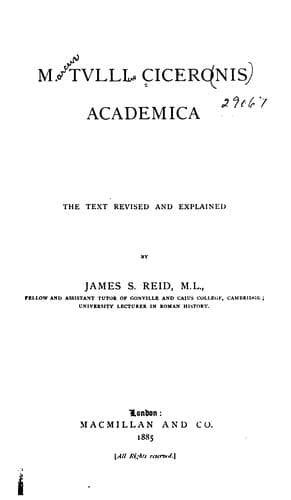
Knowledge, Theory of -- Early works to 1800; Philosophy -- Early works to 1800
§§30--36. Summary. With respect to physical science, we might urge that
nature has constructed man with great art. His mind is naturally formed
for the attainment of knowledge (30). For this purpose the mind uses
the senses, and so gradually arrives at virtue, which is the perfection
of the reason. Those then who deny that any certainty can be attained
through the senses, throw the whole of life into confusion (31). Some
sceptics say "we cannot help it." Others distinguish between the
absolute absence of certainty, and the denial of its absolute presence.
Let us deal with these rather than with the former (32). Now they on
the one hand profess to distinguish between true and false, and on the
other hold that no absolutely certain method for distinguishing between
true and false is possible (33). This is absurd, a thing cannot be
known at all unless by such marks as can appertain to no other thing.
How can a thing be said to be "evidently white," if the possibility
remains that it may be really black? Again, how can a thing be
"evident" at all if it may be after all a mere phantom (34)? There is
no definite mark, say the sceptics, by which a thing may be known.
Their "probability" then is mere random guess work (35). Even if they
only profess to decide after careful pondering of the circumstances, we
reply that a decision which is still possibly false is useless (36).
§30. _Physicis_: neuter not masc.; cf. I. 6. _Libertatem et licentiam_:
_et_ = "and even." _Libertas_ = παρρησια as often in Tacitus. _Abditis
rebus et obscuris_: cf. n. on I. 15, and the word συνεσκιασμενος Sext.
_Adv. Math._ VII. 26. _Lucem eripere_: like _tollere_ (n. on 26), cf. 38,
103 and _N.D._ I. 6. For the sense see n. on 16, also 61. _Artificio_: this
word is used in Cic. as equivalent to _ars_ in all its senses, cf. 114 and
_De Or._ II. 83. _Fabricata esset_: the expression is sneered at in 87.
_Quem ad modum primum_: so Halm rightly for MSS. _prima_ or _primo_, which
latter is not often followed by _deinde_ in Cicero. _Primum_ is out of
position, as in 24. _Appetitio pulsa_: = _mota_, set in motion. For ‛ορμη
see 24. _Intenderemus_: as in the exx. given in 20. _Fons_: "reservoir,"
rather than "source" here. It will be noted that συγκαταθεσις must take
place before the ‛ορμη is roused. _Ipse sensus est_: an approach to this
theory is made in Plat. _Theaet._ 185, 191. Cf. especially Sext. _Adv.
Math._ VII. 350 και ‛οι μεν διαφερειν αυτην των αισθησεων, ‛ως ‛οι πλειους,
‛οι δε αυτην ειναι τας αισθησεις ... ‛ης στασεως ηρξε Στρατον. All powers
of sensation with the Stoics, who are perhaps imitated here, were included
in the ‛ηγεμονικον, cf. n. on I. 38. _Alia quasi_: so Faber for _aliqua_.
"_In vera et aperta partitione nec Cicero nec alius quisquam aliquis--alius
dixit, multo minus alius--aliquis_," _M.D.F._ III. 63. Goer. on the other
hand says he can produce 50 exx.
Public-domain text, read in full here on John Shaqi.
Reviews
Reviews
No reviews yet
Be the first to share your thoughts on this work.
Elsewhere in the archive
Join the Discussion
Join the discussion
Sign in to leave a comment or review.
Sign InorCreate an account