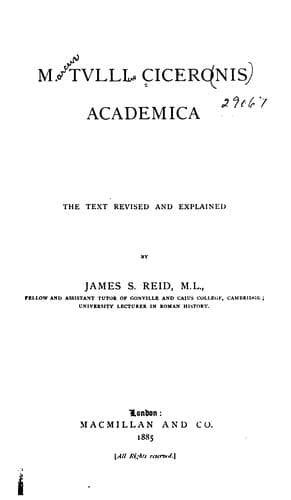
Knowledge, Theory of -- Early works to 1800; Philosophy -- Early works to 1800
§35. _Neminem_ etc.: they are content to make strong statements without any
mark of certainty. _Primo quasi adspectu_: the _merely_ πιθανη φαντασια is
here meant; see 33.
§36. _Ex circumspectione_, etc.: the διεξωδευμενη; see n. on 33. _Primum
quia ... deinde_: for the slight anacoluthia, cf. _M.D.F_ ed. II. p. 796.
_Iis visis_, etc.: i.e. if you have a number of _things_, emitting a number
of _appearances_, and you cannot be sure of uniting each _appearance_ to
the _thing_ from which it proceeds, then you can have no faith in any
_appearance_ even if you have gone through the process required by
Carneades' rules. _Ad verum ipsum_: cf. 40. _Quam proxime_: cf. 47, and
also 7. _Insigne_: σημειον, the same as _nota_ and _signum_ above. _Quo
obscurato_: so Lamb. for MSS. _obscuro_ which Halm keeps. Cf. _quam
obscurari volunt_ in 42 and _quo sublato_ in 33. _Argumentum_: Cic. seems
to be thinking of the word τεκμηριον, which, however, the Stoics hardly
use. _Id quod significatur_: το σημειωντον in Sext.
§§37--40. Summary The distinction of an animal is to act. You must
either therefore deprive it of sensation, or allow it to assent to
phenomena (37). Mind, memory, the arts and virtue itself, require a
firm assent to be given to some phenomena, he therefore who does away
with assent does away with all action in life (38, 39).
§37. _Explicabamus_: 19--21 and 30 (_quae vis esset in sensibus_).
_Inanimum_: not _inanimatum_, cf. _M.D.F_. IV. 36. _Agit aliquid_: I. 23.
_Quae est in nostra_: Walker's insertion of _non_ before _est_ is needless,
cf. n. on I. 40. It is the impact of the sensation from without, not the
assent given to it, that is involuntary (Sext. _A.M._ VIII. 397 το μεν γαρ
φαντασιωθηναι αβουλητον ην). For _in potestate_ cf. _De Fato_ 9, _N.D._ I.
69
§38. _Eripitur_: cf. 30. _Neque sentire_: Christ om. _neque_; but the
sceptics throughout are supposed to rob people of their senses. _Cedere_:
cf. εικειν, ειξις in Sext. _P.H._ I. 193, 230, Diog. VII. 51, των δε
αισθητικων μετα ειξεως και συγκαταθεσεως γινονται [‛αι φαντασια]; also 66
of this book. Οικειον: cf. 34. _Adsentitur statim_: this really contradicts
a good deal that has gone before, esp. 20. _Memoriam_: cf. 22. _In nostra
potestate_: this may throw light on fragm. 15 of the _Ac. Post._, which
see.
§39. _Virtus_: even the Stoics, who were fatalists as a rule, made moral
action depend on the freedom of the will; see n. on I. 40. _Ante videri
aliquid_ for the doctrine cf. 25, for the passive use of _videri_, n. on
25. _Adsentiatur_: the passive use is illustrated by Madv. _Em._ 131, the
change of construction from infin. to subj. after _necesse est_ on _D.F._
V. 25. _Tollit e vita_: so _De Fato_ 29.
Public-domain text, read in full here on John Shaqi.
Reviews
Reviews
No reviews yet
Be the first to share your thoughts on this work.
Elsewhere in the archive
Join the Discussion
Join the discussion
Sign in to leave a comment or review.
Sign InorCreate an account