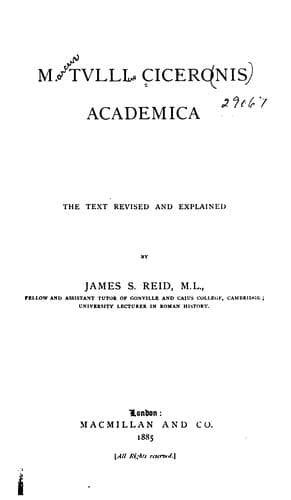
Knowledge, Theory of -- Early works to 1800; Philosophy -- Early works to 1800
When Cicero began to write, the Latin language may be said to have been
destitute of a philosophical literature. Philosophy was a sealed study to
those who did not know Greek. It was his aim, by putting the best Greek
speculation into the most elegant Latin form, to extend the education of
his countrymen, and to enrich their literature. He wished at the same time
to strike a blow at the ascendency of Epicureanism throughout Italy. The
doctrines of Epicurus had alone appeared in Latin in a shape suited to
catch the popular taste. There seems to have been a very large Epicurean
literature in Latin, of which all but a few scanty traces is now lost. C.
Amafinius, mentioned in the _Academica_[113], was the first to write, and
his books seem to have had an enormous circulation[114]. He had a large
number of imitators, who obtained such a favourable reception, that, in
Cicero's strong language, they took possession of the whole of Italy[115].
Rabirius and Catius the Insubrian, possibly the epicure and friend of
Horace, were two of the most noted of these writers. Cicero assigns various
reasons for their extreme popularity: the easy nature of the Epicurean
physics, the fact that there was no other philosophy for Latin readers, and
the voluptuous blandishments of pleasure. This last cause, as indeed he in
one passage seems to allow, must have been of little real importance. It is
exceedingly remarkable that the whole of the Roman Epicurean literature
dealt in an overwhelmingly greater degree with the physics than with the
ethics of Epicurus. The explanation is to be found in the fact that the
Italian races had as yet a strong practical basis for morality in the legal
and social constitution of the family, and did not much feel the need of
any speculative system; while the general decay among the educated classes
of a belief in the supernatural, accompanied as it was by an increase of
superstition among the masses, prepared the way for the acceptance of a
purely mechanical explanation of the universe. But of this subject,
interesting and important as it is in itself, and neglected though it has
been, I can treat no farther.
These Roman Epicureans are continually reproached by Cicero for their
uncouth style of writing[116]. He indeed confesses that he had not read
them, but his estimate of them was probably correct. A curious question
arises, which I cannot here discuss, as to the reasons Cicero had for
omitting all mention of Lucretius when speaking of these Roman Epicureans.
The most probable elucidation is, that he found it impossible to include
the great poet in his sweeping condemnation, and being unwilling to allow
that anything good could come from the school of Epicurus, preferred to
keep silence, which nothing compelled him to break, since Lucretius was an
obscure man and only slowly won his way to favour with the public.
Public-domain text, read in full here on John Shaqi.
Reviews
Reviews
No reviews yet
Be the first to share your thoughts on this work.
Join the Discussion
Join the discussion
Sign in to leave a comment or review.
Sign InorCreate an account