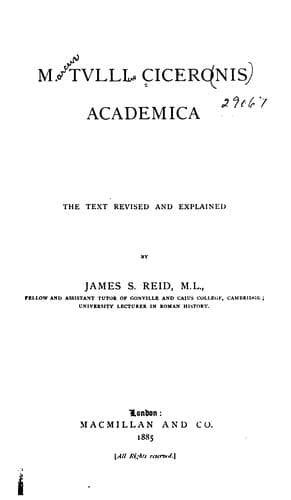
Knowledge, Theory of -- Early works to 1800; Philosophy -- Early works to 1800
§115. _Qui sibi cum oratoribus ... rexisse_: so Cic. vary often speaks of
the Peripatetics, as in _D.F._ IV. 5, V. 7. _Sustinuero_: cf. 70. _Tam
bonos_: Cic. often speaks of them and of Epicurus in this patronising way;
see e.g. _T.D._ II. 44, III. 50, _D.F._ I. 25, II. 81. For the Epicurean
friendships cf. esp. _D.F._ I. 65. _Diodoto_: cf. Introd. p. 2. _Nolumus_:
Halm and Bait., give _nolimus_; so fine a line divides the subjunctive from
the indicative in clauses like these that the choice often depends on mere
individual taste. _De sapiente loquamur_: n. on 66.
§§116--128. Summary. Of the three parts of philosophy take Physics
first. Would your _sapiens_ swear to the truth of any geometrical
result whatever? (116) Let us see which one of actual physical systems
the _sapiens_ we are seeking will select (117). He must choose _one_
teacher from among the conflicting schools of Thales, Anaximander,
Anaximenos, Anaxagoras, Xenophanes, Leucippus, Democritus, Empedocles,
Heraclitus, Melissus, Plato and Pythagoras. The remaining teachers,
great men though they be, he must reject (118). Whatever system he
selects he must know absolutely; if the Stoic, he must believe as
strongly in the Stoic theology as he does in the sunlight. If he holds
this, Aristotle will pronounce him mad; you, however, Lucullus, must
defend the Stoics and spurn Aristotle from you, while you will not
allow me even to doubt (119). How much better to be free, as I am and
not compelled to find an answer to all the riddles of the universe!
(120) Nothing can exist, say you, apart from the deity. Strato,
however, says he does not need the deity to construct the universe. His
mode of construction again differs from that of Democritus. I see some
good in Strato, yet I will not assent absolutely either to his system
or to yours (121). All these matters lie far beyond our ken. We know
nothing of our bodies, which we can dissect, while we have not the
advantage of being able to dissect the constitution of things or of the
earth to see whether she is firmly fixed or hovers in mid air (122).
Xenophanes, Hicetas, Plato and Epicurus tell strange things of the
heavenly bodies. How much better to side with Socrates and Aristo, who
hold that nothing can be known about them! (123) Who knows the nature
of mind? Numberless opinions clash, as do those of Dicaearchus, Plato
and Xenocrates. Our _sapiens_ will be unable to decide (124). If you
say it is better to choose any system rather than none, I choose
Democritus. You at once upbraid me for believing such monstrous
falsehoods (125). The Stoics differ among themselves about physical
subjects, why will they not allow me to differ from them? (126) Not
that I deprecate the study of Physics, for moral good results from it
(127). Our _sapiens_ will be delighted if he attains to anything which
seems to resemble truth.
Public-domain text, read in full here on John Shaqi.
Reviews
Reviews
No reviews yet
Be the first to share your thoughts on this work.
Elsewhere in the archive
Join the Discussion
Join the discussion
Sign in to leave a comment or review.
Sign InorCreate an account