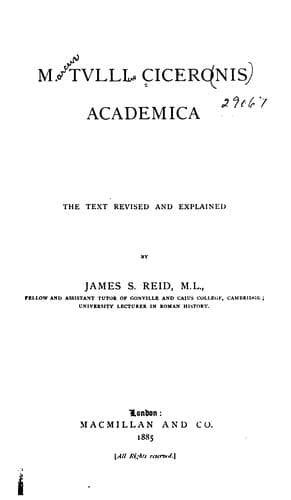
Knowledge, Theory of -- Early works to 1800; Philosophy -- Early works to 1800
Before I proceed to Ethics, I note your
weakness in placing all perceptions on the same level. You must be
prepared to asseverate no less strongly that the sun is eighteen times
as large as the earth, than that yon statue is six feet high. When you
admit that all things can be perceived no more and no less clearly than
the size of the sun, I am almost content (128).
§116. _Tres partes_: cf. I. 19. _Et a vobismet_: "and especially by you".
The threefold division was peculiarly Stoic, though used by other schools,
cf. Sext. _P.H._ II. 13 (on the same subject) ‛οι Στωικοι και αλλοι τινες.
For other modes of dividing philosophy see Sext. _A.M._ VII. 2. _At illud
ante_: this is my em. for the MSS. _velut illud ante_, which probably arose
from a marginal variant "_vel ut_" taking the place of _at_; cf. a similar
break in 40 _sed prius_, also in 128 _at paulum ante_. Such breaks often
occur in Cic., as in _Orator_ 87 _sed nunc aliud_, also _T.D._ IV. 47
_repenam fortasse, sed illud ante._ For _velut_ Halm writes _vel_ (which
Bait. takes), Dav. _verum_. _Inflatus tumore_: cf. _De Off._ I. 91 _inflati
opinionibus._ Bentl. read _errore_. _Cogere_: this word like αναγκαζειν and
βιαζεσθαι often means simply to argue irresistibly. _Initia_: as in 118,
bases of proof, themselves naturally incapable of proof, so αρχαι in Gk.
_Digitum_: cf. 58, 143. _Punctum esse_ etc.: σημειον εστιν ου μερος ουθεν
(Sext. _P.H._ III. 39), στιγμη = το αμερες (_A.M._ IX. 283, 377).
_Extremitatem_: = επιφανειαν. _Libramentum_: so this word is used by Pliny
(see Forc.) for the slope of a hill. _Nulla crassitudo_: in Sext. the
επιφανεια is usually described not negatively as here, but positively as
μηκος μετα πλατους (_P.H._ III. 39), περας (_extremitas_) σοματος δυο εχον
διαστασεις, μηκος και πλατος (_A.M._ III. 77). _Liniamentum ... carentem_:
a difficult passage. Note (1) that the line is defined in Greek as μηκος
απλατες. (Sext. as above), (2) that Cic. has by preference described the
point and surface negatively. This latter fact seems to me strong against
the introduction of _longitudinem_ which Ursinus, Dav., Orelli, Baiter and
others propose by conjecture. If anything is to be introduced, I would
rather add _et crassitudine_ before _carentem_, comparing I. 27 _sine ulla
specie et carentem omni illa qualitate_. I have merely bracketed
_carentem_, though I feel Halm's remark that a verb is wanted in this
clause as in the other two, he suggests _quod sit sine_. Hermann takes
_esse_ after _punctum_ as strongly predicative ("there _is_ a point,"
etc.), then adds _similiter_ after _liniamentum_ and ejects _sine ulla_.
Observe the awkwardness of having the _line_ treated of after the
_superficies_, which has induced some edd. to transpose. For _liniamentum_
= _lineam_ cf. _De Or._ I. 187. _Si adigam_: the fine em. of Manut. for _si
adiiciamus_ of MSS. The construction _adigere aliquem ius iurandum_ will be
found in Caes. _Bell. Civ._ I. 76, II. 18, qu.
Public-domain text, read in full here on John Shaqi.
Reviews
Reviews
No reviews yet
Be the first to share your thoughts on this work.
Elsewhere in the archive
Join the Discussion
Join the discussion
Sign in to leave a comment or review.
Sign InorCreate an account