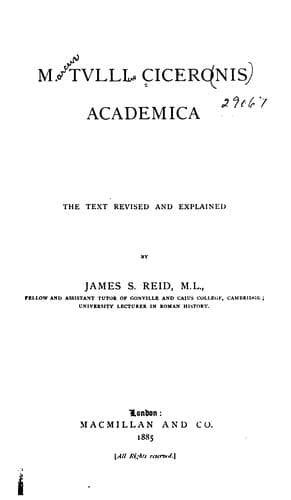
Knowledge, Theory of -- Early works to 1800; Philosophy -- Early works to 1800
In the many passages where Cicero speaks of him, he seldom omits to mention
his _sapientia_, which implies a certain knowledge of philosophy. He was,
says Cicero, the kindest, the most upright, the wisest, the holiest of
men[228]. He was a man of universal merit, of surpassing worth, a second
Laelius[229]. It is easy to gather from the _De Oratore_, in which he
appears as an interlocutor, a more detailed view of his accomplishments.
Throughout the second and third books he is treated as the lettered man,
par excellence, of the company[230]. Appeal is made to him when any
question is started which touches on Greek literature and philosophy. We
are especially told that even with Greeks his acquaintance with Greek, and
his style of speaking it, won admiration[231]. He defends the Greeks from
the attacks of Crassus[232]. He contemptuously contrasts the Latin
historians with the Greek[233]. He depreciates the later Greek rhetorical
teaching, while he bestows high commendation on the early sophists[234].
The systematic rhetoric of Aristotle and Theophrastus is most to his
mind[235]. An account is given by him of the history of Greek speculation
in Italy[236]. The undefiled purity of his Latin style made him seem to
many the only speaker of the language[237]. He had written a history of his
own deeds, in the style of Xenophon, which Cicero had imitated[238], and
was well known as a wit and writer of epigrams[239].
Although so much is said of his general culture, it is only from the
_Academica_ that we learn definitely his philosophical opinions. In the _De
Oratore_, when he speaks of the visit of Carneades to Rome[240], he does
not declare himself a follower of that philosopher, nor does Crassus, in
his long speech about Greek philosophy, connect Catulus with any particular
teacher. The only Greek especially mentioned as a friend of his, is the
poet Antipater of Sidon[241]. Still it might have been concluded that he
was an adherent either of the Academic or Peripatetic Schools. Cicero
repeatedly asserts that from no other schools can the orator spring, and
the whole tone of the _De Oratore_ shows that Catulus could have had no
leaning towards the Stoics or Epicureans[242]. The probability is that he
had never placed himself under the instruction of Greek teachers for any
length of time, but had rather gained his information from books and
especially from the writings of Clitomachus. If he had ever been in actual
communication with any of the prominent Academics, Cicero would not have
failed to tell us, as he does in the case of Antonius[243], and
Crassus[244]. It is scarcely possible that any direct intercourse between
Philo and Catulus can have taken place, although one passage in the
_Lucullus_ seems to imply it[245]. Still Philo had a brilliant reputation
during the later years of Catulus, and no one at all conversant with Greek
literature or society could fail to be well acquainted with his
opinions[246].
Public-domain text, read in full here on John Shaqi.
Reviews
Reviews
No reviews yet
Be the first to share your thoughts on this work.
Join the Discussion
Join the discussion
Sign in to leave a comment or review.
Sign InorCreate an account