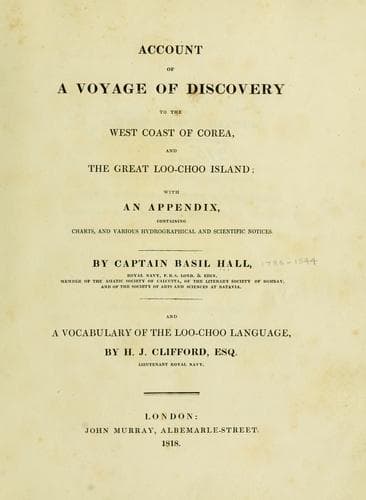
Account of a voyage of discovery to the west coast of Corea, and the great Loo-Choo IslandHall, Basil
History
Account of a voyage of discovery to the west coast of Corea, and the great Loo-Choo Island
Hall, Basil
Korea -- Description and travel; Ryukyu Islands -- Description and travel
The religion of Loo-choo appears to be that of Fo, said to be introduced
by the bodzes one thousand years ago[16]. We found great difficulty in
discovering any thing precise on this subject from the natives; but from
all that we could gather, religion does not appear to be made a matter
of general instruction as in Europe, being left, as in China, to the
priests. This we infer from the careless way in which the subject was at
all times treated by the natives, and the ignorance which they
professed of the forms and ceremonies used in the temples. The bodzes
are not respected or esteemed in society; they are prevented from
marrying, and are not allowed to eat meat: few people associate with
them, and even the children turn them into ridicule. On the occasion of
the Loo-choo funeral service over the grave of the seaman, the bodzes
stood behind, and were not called upon to officiate, the service being
entirely performed by Jeeroo.
In the large temple we saw three gilt idols and various pictures; but
with the exception of the funeral service just alluded to, we never met
with any thing in the least degree resembling a religious ceremony. The
bodzes kept the temple clean swept, and took care of the walks and
hedges, and this appeared to be their only employment. It is fair to
suppose, however, that the occupation of the temple by us may have
caused a temporary cessation of their religious observances.
They have large tombs or cemeteries for their dead, being mostly of the
Chinese form, viz. that of a horse-shoe. They are formed of stones and
mortar, and are covered with a coat of cheenam, (shell lime), which is
always kept nicely whitewashed and clean swept: some are more highly
finished than others; their size varies from twenty to thirty feet in
length, by twelve to fourteen broad. The coffin, when closed, is placed
in the vault under the tomb, and is not touched for six or seven years,
by which time the flesh is found to have separated and wasted away; the
bones are then collected, and put into jars ranged in rows on the inside
of the vault. Burning is never used at any stage of the proceedings, nor
under any circumstances. In the course of time, when these vaults become
crowded, the vases are removed to houses appropriated to their reception
above ground: such must have been the building described by Mr. Clifford
in the village near Port Melville. The lower orders, who cannot afford
these expensive tombs, take advantage of hollow places in the rocks,
which by a little assistance are made secure vaults. In the cliffs
behind the village of Oonting, the galleries cut for the reception of
the vases must have been the work of men possessed of power and
authority. Not being fully aware what the Chinese customs are with
respect to the dead, in ordinary cases, it is impossible for us to say
how nearly they resemble those of Loo-choo, but there are certainly some
points of resemblance.
Public-domain text, read in full here on John Shaqi.
Reviews
Reviews
No reviews yet
Be the first to share your thoughts on this work.
Elsewhere in the archive
Join the Discussion
Join the discussion
Sign in to leave a comment or review.
Sign InorCreate an account