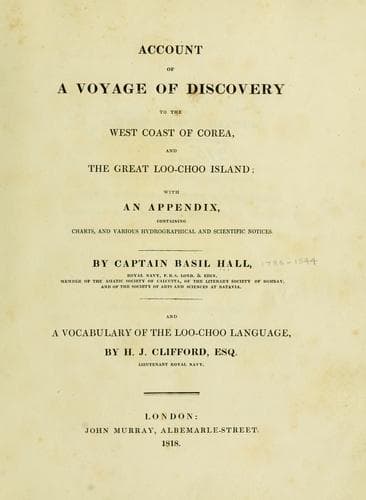
Account of a voyage of discovery to the west coast of Corea, and the great Loo-Choo IslandHall, Basil
History
Account of a voyage of discovery to the west coast of Corea, and the great Loo-Choo Island
Hall, Basil
Korea -- Description and travel; Ryukyu Islands -- Description and travel
From Mr. Clifford's notes on the Loo-choo inscriptions, I have extracted
the following particulars.
"A number of carved stones, called by the natives Kawroo, were found at
many places, particularly in the groves on the hill. The Kawroo is two
feet long, by one wide, and one high; it is excavated a little on the
upper part, on which an offering of rice is placed. On the sides of this
stone are carved a variety of characters, denoting the rank of the
person who makes the offering, as well as the object of his petition,
together with the date.
"Two of these inscriptions, copied at the time, have since been
translated by a gentleman acquainted with the Chinese characters. The
first gives an account of a man about to sail for China, in the reign of
Kien Lung, the late monarch of that country; this person implores the
divine aid in protecting him during his voyage. The other is dated in
the twenty-first year of the reign of Kia-King, the present emperor of
China, answering to the year 1816, in which we visited Loo-choo. This is
an invocation to the deity for success in a literary pursuit.
"Two narrow strips of paper, with characters inscribed on them, which by
consent of the natives were taken from a pillar in the temple, and which
have since been translated, prove to be invocations, one to the supreme
deity, and the other to the evil spirit. The first is on a slip of
paper, two feet long, by two inches wide, and contains a supplication
for pardon. The latter invocation begins by seven rows of the character
symbolical of the Devil. In the upper line there are seven, and in the
last one, so that a triangular page is formed of twenty-eight
characters, each signifying the Devil; and the prayer itself is written
in a narrow perpendicular line underneath; the whole inscription
resembling in form a kite with a long tail attached to it."
Public-domain text, read in full here on John Shaqi.
Reviews
Reviews
No reviews yet
Be the first to share your thoughts on this work.
Elsewhere in the archive
Join the Discussion
Join the discussion
Sign in to leave a comment or review.
Sign InorCreate an account