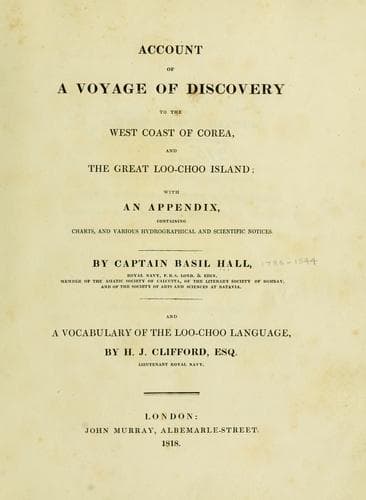
Account of a voyage of discovery to the west coast of Corea, and the great Loo-Choo IslandHall, Basil
History
Account of a voyage of discovery to the west coast of Corea, and the great Loo-Choo Island
Hall, Basil
Korea -- Description and travel; Ryukyu Islands -- Description and travel
We had frequent opportunities of seeing their method of making salt, and
an account of it may, perhaps, be interesting. Near the sea, large level
fields are rolled or beat so as to have a hard surface. Over this is
strewn a sort of sandy black earth, forming a coat about a quarter of an
inch thick. Rakes and other implements are used to make it of a uniform
thickness, but it is not pressed down. During the heat of the day, men
are employed to bring water in tubs from the sea, which is sprinkled
over these fields by means of a short scoop. The heat of the sun, in a
short time, evaporates the water, and the salt is left in the sand,
which is scraped up and put into raised receivers of masonry about six
feet by four, and five deep. When the receiver is full of the sand, sea
water is poured on the top, and this, in its way down, carries with it
the salt left by evaporation. When it runs out below at a small hole, it
is a very strong brine; this is reduced to salt by being boiled in
vessels about three feet wide and one deep. The cakes resulting from
this operation are an inch and a half in thickness.
Of the population of this island we know nothing satisfactory: the
natives invariably pleaded ignorance themselves; and as we had no
precise data, our estimates were made at random, and as they never
agreed with each other, they are not worthy of notice. From the south
point of this island, to five or six miles north of Napakiang, an extent
of sixteen or eighteen miles, the country is highly cultivated, and is
almost entirely covered with villages. All round Port Melville too there
are populous villages, but the north, north-east and eastern places are
thinly peopled, and not cultivated to any extent. We saw nothing like
poverty or distress of any kind: every person that we met seemed
contented and happy. We saw no deformed people, nor any who bore
indications of disease, except a few who were marked with the small-pox.
The style of living of those with whom we associated is generous and
free; their custom of carrying about their dinner in boxes, and making
little pic-nic parties, is peculiarly striking, and they appeared fully
sensible of the advantage of bringing people together in this way, and
expressed much satisfaction at the ready way in which we fell into a
custom from which all formality was dismissed. They shewed, moreover, a
good deal of discernment, and could adapt themselves to the character of
the particular persons they happened to be in company with, in a manner
very remarkable; but this was evidently the result not of cunning, but
of correct feelings, and of a polite habit of thinking.
Public-domain text, read in full here on John Shaqi.
Reviews
Reviews
No reviews yet
Be the first to share your thoughts on this work.
Elsewhere in the archive
Join the Discussion
Join the discussion
Sign in to leave a comment or review.
Sign InorCreate an account