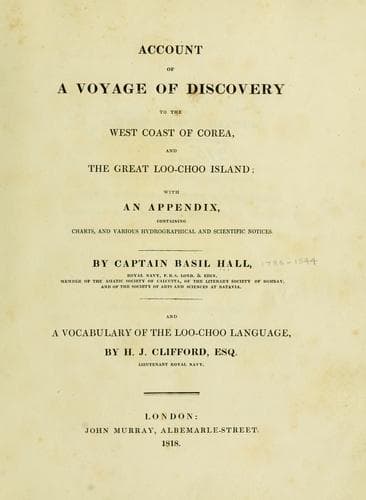
Account of a voyage of discovery to the west coast of Corea, and the great Loo-Choo IslandHall, Basil
History
Account of a voyage of discovery to the west coast of Corea, and the great Loo-Choo Island
Hall, Basil
Korea -- Description and travel; Ryukyu Islands -- Description and travel
Their mode of dressing the ground is neat, and resembles the Chinese,
particularly in manuring and irrigating it. This is most attended to
where the sugar-cane is cultivated: they have, besides, tobacco, wheat,
rice, Indian corn, millet, sweet potatoes, brinjals, and many other
vegetables. The fields, which are nicely squared, have convenient walks
on the raised banks running round each. Along the sides of the hills,
and round the villages, the bamboo and rattan grow to a considerable
size. The pine is the most conspicuous tree on the island, growing to a
great height and size, which we infer from seeing canoes built with
planks several feet wide; the trees, however, near the temple at
Napakiang were not above ninety feet high, and from three to four in
girt. The banyan-tree of India was seen at several places; the finest
one overhung the small temple at Napakiang, which circumstance led to
the enquiry whether, as in India, this tree is held sacred, but we could
gain no information on this subject.
In a little plot of ground in the temple garden, Mr. Phillips, purser of
the Alceste, sowed mustard-seed, peas, and a variety of other seeds, the
natives taking his directions for their culture. Our total ignorance of
botany prevented our making any observations on this subject while at
Loo-choo; but to supply this deficiency, we collected specimens of every
plant at the place. These were preserved between sheets of brown paper,
and given afterwards to Mr. Abel, the naturalist of the embassy, in
order to be arranged; but they were subsequently lost, along with the
whole of that gentleman's collection.
Of their manufactures it is difficult to speak with certainty. By their
own account the silks which they wear are Chinese, but the cotton cloths
are made on this and the neighbouring islands; the printed patterns of
these are not without elegance. We saw no weaving looms, but as we were
only in a few houses, this is not surprising: the webs are thirty-six
feet long, and fourteen inches broad. Tobacco-pipes and fans are made at
Loo-choo; as well as the sepulchral vases, of which there is a
manufactory at Napakiang, from whence they are exported to Oonting, and
other parts of the island. Some of the pouches of the chiefs were made
of cloth, which they say comes from China; it is exactly like our broad
cloth. We tried in vain to learn what goods they send to China in
exchange for silks: perhaps sulphur forms a part, which these islands
are said to produce, as well as tin. From the number of vessels
constantly sailing out and in, it appears that they must have some
trade, but our enquiries on this and many other topics, though
sedulously pursued, led to nothing satisfactory, owing probably rather
to our ignorance of the language, than to any wish on their part to
withhold information; because, on topics which had no reference to the
royal family or the women, they in general spoke freely.
Public-domain text, read in full here on John Shaqi.
Reviews
Reviews
No reviews yet
Be the first to share your thoughts on this work.
Elsewhere in the archive
Join the Discussion
Join the discussion
Sign in to leave a comment or review.
Sign InorCreate an account