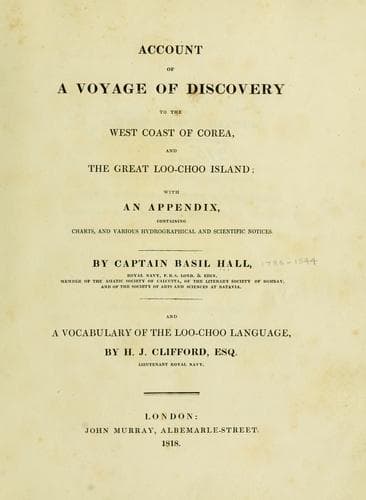
Account of a voyage of discovery to the west coast of Corea, and the great Loo-Choo IslandHall, Basil
History
Account of a voyage of discovery to the west coast of Corea, and the great Loo-Choo Island
Hall, Basil
Korea -- Description and travel; Ryukyu Islands -- Description and travel
Circle.
26th Oct. 26 . 13 . 29 20th Oct. P.M.{ 26 . 13 . 58}
{ 26 . 13 . 47} sext.
{ 26 . 13 . 57}
22d mean 2 A.M.& 2 P.M. 26 . 13 . 24} circle.
26th 3 P.M. 26 . 13 . 29}
Latitude by mean of 3 meridian altitudes 26º. 13'. 39" sextant and circle.
mean of 5 altitudes near noon 26 . 13 . 50 sextant.
mean of 3 do. do. 26 . 13 . 28 circle.
------------
Mean latitude 26 . 13 . 39 north.
* * * * *
VARIATION OF THE COMPASS AT NAPAKIANG.
The declination of the magnetic meridian was ascertained with
considerable precision by means of the transit azimuth instrument: the
needle seldom showed the same variation, as it oscillated about ten
minutes, but the mean position of the magnetic meridian was 52' 10" west
of the true. A coral reef was selected for the place of these
observations, in order to avoid the attraction arising from buildings,
or from inequalities in the ground.
* * * * *
_Variation observed on board by Walker's Azimuth Compass._
29th Sept. 1816, P.M. ship's head W. by S. variation by
1st azimuth 0º. 51'. 30" west.
2nd 0 . 53 . 30
3rd 1 . 17 . 30
Amplitude 1 . 15 . 00
30th A.M. 1st azimuth 0 . 55 . 30
2nd 0 . 34 . 15
3d Oct. A.M. ship's head E.N.E. 1st azimuth 0 . 37 . 00
2nd 0 . 48 . 00
-----------
Variation by mean of 7 azimuths and 1 amplitude 0 . 52 . 39 west.
TABLE OF OBSERVATIONS
MADE WITH
DR. WOLLASTON'S DIP SECTOR:
WITH AN ENGRAVING, AND A DESCRIPTION OF THE INSTRUMENT, AND DIRECTIONS
FOR ITS USE.
[Illustration: Wollaston's Dip Sector]
EXPLANATION OF THE DIP SECTOR,
AND
REMARKS ON THE OBSERVATIONS MADE WITH IT IN HIS MAJESTY'S SLOOP LYRA.
In our tables for apparent dip of the visible horizon at different
heights from the sea, as calculated from the known curvature of the
earth, allowance is made for the refraction of the atmosphere, on a
supposition of its being constant, but as it is known to vary, the
tabular dip will often be erroneous, and, consequently, altitudes taken
under different states of the atmosphere, will exhibit different instead
of corresponding results.
Public-domain text, read in full here on John Shaqi.
Reviews
Reviews
No reviews yet
Be the first to share your thoughts on this work.
Elsewhere in the archive
Join the Discussion
Join the discussion
Sign in to leave a comment or review.
Sign InorCreate an account