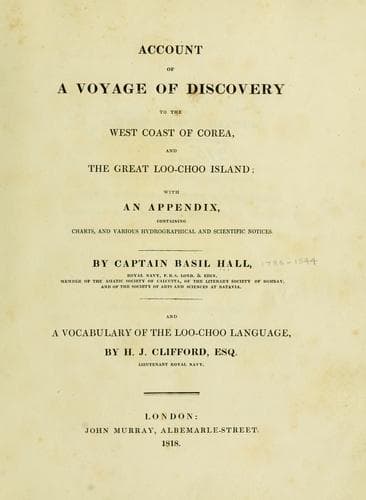
Account of a voyage of discovery to the west coast of Corea, and the great Loo-Choo IslandHall, Basil
History
Account of a voyage of discovery to the west coast of Corea, and the great Loo-Choo Island
Hall, Basil
Korea -- Description and travel; Ryukyu Islands -- Description and travel
It is foreign to the present purpose to shew what the causes are which
have most effect in raising or depressing the apparent horizon. It may
be sufficient to mention, that changes in the relative temperature of
the air and the sea must produce changes in the refraction near the
surface. Dr. Wollaston has published two papers in the Philosophical
Transactions on this subject, in the volumes for 1800 and 1803, and to
these I beg to refer the reader for precise information upon this very
curious subject.
The object which this sector proposes to attain, is the actual
admeasurement of the dip angle; that is, to ascertain how much the
visible horizon is depressed below the horizontal plane passing through
the eye of the observer. The instrument is so contrived as to measure
double the dip angle twice over, so that we obtain four times the
required dip, and one quarter of this angle is what must be applied to
vertical angles, measured from that part of the horizon which has been
observed.
Figure I. is the instrument seen in perspective, and Fig. II. is a plan
of it with the telescope removed. In order to explain its use, let A and
B (Fig. II.) represent the two reflecting glasses at right angles to the
plane of the instrument, and also nearly at right angles to each other.
It is clear that when the plane of the instrument is held vertically, an
eye situated at E, and looking through the unsilvered part of the glass
A at a distant point C, will at the same time see by joint reflection
from both glasses, another distant point D at 180º from C; and D will
appear to correspond with C, if a suitable motion be given to the index
glass B by the tangent screw F.
The instrument may now be supposed to measure the arc CZD. If the points
C and D be each three minutes farther from the zenith than 90º, the
entire angle will then exceed 180º by double that quantity. The relative
position of the glasses then corresponds to 180º 6', and the six minutes
of excess would be shewn on the arc at F if there were no index error.
But, by reason of the index error, the real quantity will not be known
till a similar observation has been made with the instrument in an
opposite direction.
If the instrument be now inverted, so that the unsilvered glass is
uppermost, the arc intended to be measured is CND, or the sum of the
distances of the points C and D from the Nadir instead of the Zenith,
which of course falls short of 180º by as much as the former arc
exceeded that quantity.
The difference of the two arcs is consequently twelve minutes, and if
the index be now moved till the objects C and D appear to correspond,
the amount of this double difference will be shewn by the _change of
position_ of the vernier.
Hence it is evidently unnecessary that the index error should be
previously known, and even preferable that its amount should be such as
to avoid the needless introduction of negative quantities by positions
on different sides of zero.
Public-domain text, read in full here on John Shaqi.
Reviews
Reviews
No reviews yet
Be the first to share your thoughts on this work.
Elsewhere in the archive
Join the Discussion
Join the discussion
Sign in to leave a comment or review.
Sign InorCreate an account