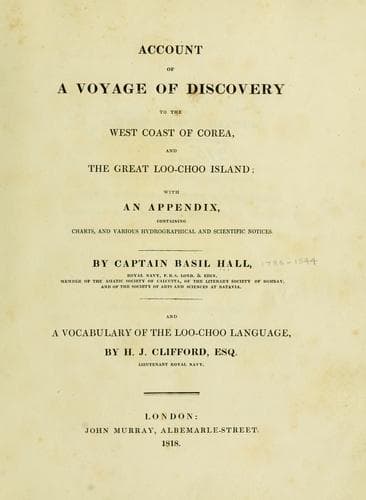
Account of a voyage of discovery to the west coast of Corea, and the great Loo-Choo IslandHall, Basil
History
Account of a voyage of discovery to the west coast of Corea, and the great Loo-Choo Island
Hall, Basil
Korea -- Description and travel; Ryukyu Islands -- Description and travel
It is advisable to take several observations, and the safest way is to
take one first with the index glass uppermost, and then with the
instrument inverted, after which to return to the first, and so on for
two or three times each way.
In the pages which follow, there is given a table containing the result
of all the observations made during this voyage, preceded by several
sets of observations in the fullest detail. From the table it will be
observed how seldom the dip, actually measured, agrees with that
inferred from the mean refraction. Some of these experiments shew very
remarkable differences, and point out the great utility of this
instrument.
The practical navigator, particularly if he has been in hot climates,
will recollect how discordant his observations for latitude always were,
and how few even of the best observers agree in their determination of
the latitude of the same place, simple as the observation is thought to
be. The cause is quite clear; and though it equally affects altitudes
taken for absolute time, the disagreement is less obvious, and it will
often happen that a chronometer going extremely well appears to vary
every day from inaccuracy in the observations. Thus it is, I think,
generally admitted, that it is almost impossible to rate a chronometer
from altitudes observed with the sea horizon. Nor is this difficulty
removed by taking equal altitudes, because the refraction in all
probability will be different at the two observations. With an
artificial horizon, indeed, the changes in refraction are not felt,
because, at a considerable elevation above the horizon, the changes are
very trifling. But it often happens in practice, that the artificial
horizon cannot be used, and we are then reduced to the sea horizon,
where the changes of refraction are always the greatest. In the Yellow
Sea, for instance, we had no opportunity of landing during all the time
that the squadron was at anchor, till the day before we sailed. So that
during nearly a fortnight that the ships were at anchor, the sea horizon
was necessarily used. I need only to refer to the observations taken off
the Pei-ho, viz. from No. 37 to 62, to shew how extremely fallacious the
results must have been.
It is much to be wished that this excellent instrument should be brought
into general use in navigation.
THE FOLLOWING EIGHT OBSERVATIONS ARE SET DOWN IN THE FULLEST DETAIL, IN
ORDER TO SHEW THE METHOD USED IN RECORDING THEM.
No. 31.
YELLOW SEA.
_July 23, 1816._--6 P.M.
Index uppermost. Instrument inverted.
Public-domain text, read in full here on John Shaqi.
Reviews
Reviews
No reviews yet
Be the first to share your thoughts on this work.
Elsewhere in the archive
Join the Discussion
Join the discussion
Sign in to leave a comment or review.
Sign InorCreate an account