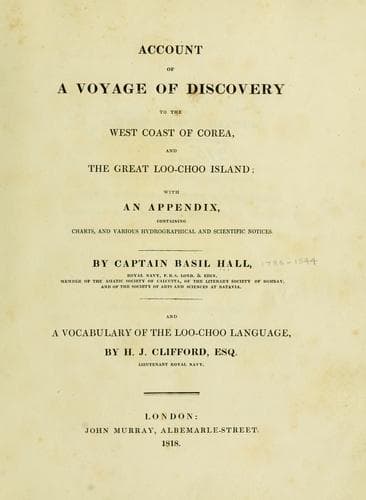
Account of a voyage of discovery to the west coast of Corea, and the great Loo-Choo IslandHall, Basil
History
Account of a voyage of discovery to the west coast of Corea, and the great Loo-Choo Island
Hall, Basil
Korea -- Description and travel; Ryukyu Islands -- Description and travel
In the preceding description, it is supposed that the eye is looking
directly through the unsilvered glass at the horizon, and that it also
perceives the opposite horizon after two reflections; but an inspection
of the figure will shew that the observer's head would necessarily
intercept the rays from the horizon behind him. To obviate this, both
the direct and the reflected rays are received in coming from the
unsilvered glass, (and after passing through the field-glass of the
telescope) on a mirror placed at an angle of 45º, which reflects them to
the eye. By this ingenious contrivance, the obstruction is removed, and
the opposite points of the horizon may be both seen at one moment.
In practice, it is most convenient to direct the telescope to the same
part of the horizon in both cases. Thus, if the east and west parts of
the horizon be observed, and that the index glass be uppermost, and
telescope pointing to the west, the observer is on the south side, and
his face must be turned to the north. When the instrument is inverted,
if the observer turn himself round at the same time, so as to face the
south, then the telescope will be pointed as before to the west; but
since the index glass is now undermost, the inferior arc will now be
measured precisely as if his face were to the north, but with the
advantage of the same lights seen in the erect position of the
instrument.
In using this instrument at sea for the first time, considerable
difficulty arises from the constant change in the plane of the
instrument from the perpendicular position, in which it is absolutely
necessary that it should be held, in order to obtain a correct
observation. What at first appears to be a defect, however, is a real
advantage, namely, that whenever it is held in the least degree out of
the vertical plane, the two horizons (that seen direct, and the
reflected one) cross each other, and it is only when the plane is
vertical that the horizons can appear parallel.
The object is to get the two horizons to coincide exactly, and for this
purpose it will often be necessary to have them of different shades.
This is managed, as in the sextant, by means of the screw, which raises
or lowers the telescope. When the telescope is brought nearer to the
plane of the instrument, the reflected horizon becomes dark and
distinct, but when screwed off it becomes fainter, and is not so well
defined. Practice alone can teach the degree of intensity which is most
favourable. In general it is best to have one horizon dark, and the
other light; then bring them very nearly to coincide, and wait till the
ship is steady, at which moment a slight touch of the tangent screw
brings them exactly to cover one another. It will happen, of course,
that when the coincidence is perfect, there is only one horizon to be
seen, and a doubt remains whether all is right, but a slight motion of
the instrument, by making the horizons cross each other, defines them at
once.
Public-domain text, read in full here on John Shaqi.
Reviews
Reviews
No reviews yet
Be the first to share your thoughts on this work.
Elsewhere in the archive
Join the Discussion
Join the discussion
Sign in to leave a comment or review.
Sign InorCreate an account