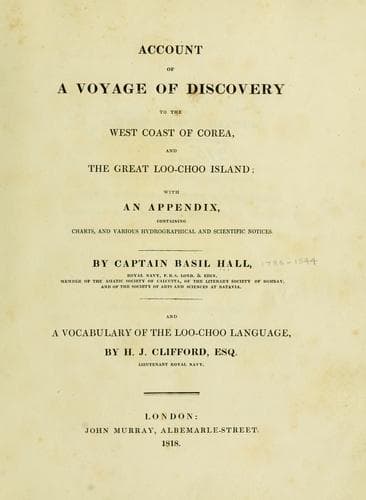
Account of a voyage of discovery to the west coast of Corea, and the great Loo-Choo IslandHall, Basil
History
Account of a voyage of discovery to the west coast of Corea, and the great Loo-Choo Island
Hall, Basil
Korea -- Description and travel; Ryukyu Islands -- Description and travel
was stirring him up with his rod, the fellow slipped his cargo of bread
into a coil of rope, and then went along with the Chief quietly enough.
The old man came back afterwards, and found the biscuit, which he
pointed out to us, to shew that it had not been taken away.
He continued for some time at the hatchway, expecting more people; but
finding none come up, he went below himself, to the main deck, and
rummaged under the guns and round the main-mast, to discover whether any
one was concealed; but finding no person there, he came again upon deck,
and shortly after went into his boat.
On returning to the Lyra, we found a number of boats anchored round her,
which looked as if they meant to keep strict watch over us. We went in
our boat to one of them, where we found the crew asleep. They seemed to
have had orders not to follow the Chief to the frigate, and were here
waiting his return. On our pointing to the shore, and making signs that
the old man with the long beard and large hat had landed, they began
immediately to get their anchor up, and called to the other boats to do
the same. In a few minutes they were all at work, and every person in
the boats joined in repeating the two words "ho ya, ho ya," the effect
of which, from a great many voices, was not unpleasing.
The cable in these boats is wound round a large reel or barrel; to the
ends of which two wheels with handles are fitted, which enables a
considerable number to apply their strength at the same moment. The
anchor is made of a dark coloured, heavy wood, with a long shank and
flukes, and a short stock crossing the former, near the crown of the
anchor, and not at the end of the shank, as with us in Europe. The mat
sails are divided into horizontal divisions by slender pieces of bamboo.
When not under sail, the boats are moved by oars having a circular piece
of wood tied to the end, and are steered by a large scull over the
stern. The bow is square above, but rises from the water in a slope,
making a small angle with the water, like the end of a coal barge, but
overhanging more. The planks are fastened together by means of square
tree-nails, which pass in a slanting direction through the plank, and
not straight, as with us.
Public-domain text, read in full here on John Shaqi.
Reviews
Reviews
No reviews yet
Be the first to share your thoughts on this work.
Join the Discussion
Join the discussion
Sign in to leave a comment or review.
Sign InorCreate an account