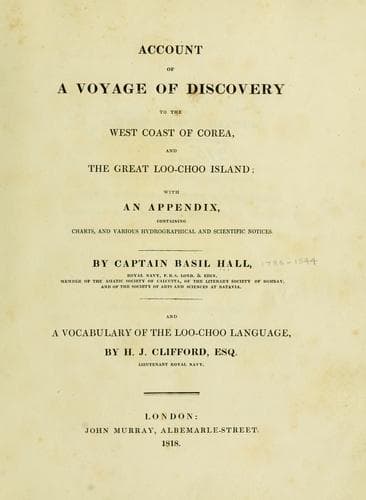
Account of a voyage of discovery to the west coast of Corea, and the great Loo-Choo IslandHall, Basil
History
Account of a voyage of discovery to the west coast of Corea, and the great Loo-Choo Island
Hall, Basil
Korea -- Description and travel; Ryukyu Islands -- Description and travel
We found the north-east end composed of a fine-grained granite[19]; the
middle of the island of a brittle micaceous schistus of a deep blue
colour[20]; the strata are nearly horizontal, but dip a little to the
south-west. This body of strata is cut across by a granite dyke[21], at
some places forty feet wide, at others not above ten; the strata in the
vicinity of the dyke are broken and bent in a remarkable manner: this
dislocation and contortion does not extend far from the walls of the
dyke, though veins of granite branch out from it to a great distance,
varying in width from three feet to the hundredth part of an inch: the
dyke is visible from the top of the cliff to the water's edge, but does
not re-appear on the corresponding cliff of an island opposite to it,
though distant only thirty yards. This island is composed of the same
schistus, and is cut in a vertical direction by a whin dyke[22], four
feet wide, the planes of whose sides lie north-east and south-west,
being at right angles to those of the great granite dyke in the
neighbourhood, which run south-east and north-west. The strata
contiguous to the whin dyke are a good deal twisted and broken, but not
in the same degree as at their contact with the granite dyke. The whin
dyke is formed of five layers or sets of prisms laid across in the usual
way.
Beyond the small island cut by the whin dyke, at the distance of only
forty or fifty feet, we came to an island rising abruptly out of the
sea, and presenting a high rugged cliff of breccia[23], fronting that on
which the granite dyke is so conspicuous: the junction of this rock with
the schistus cut by the granite and the whin would have been
interesting; but although we must have been at times within a few yards
of it, the actual contact was every where hid by the sea.
The whole of the south-west end of this island is formed of breccia,
being an assemblage of angular and water-worn pieces of schistus,
quartz, and some other rocks, the whole having the appearance of a
great shingle beach and cliffs. The fragments of the schistus in this
rock are similar to that which forms the cliff first spoken of.
(Specimen 8.)
Public-domain text, read in full here on John Shaqi.
Reviews
Reviews
No reviews yet
Be the first to share your thoughts on this work.
Elsewhere in the archive
Join the Discussion
Join the discussion
Sign in to leave a comment or review.
Sign InorCreate an account