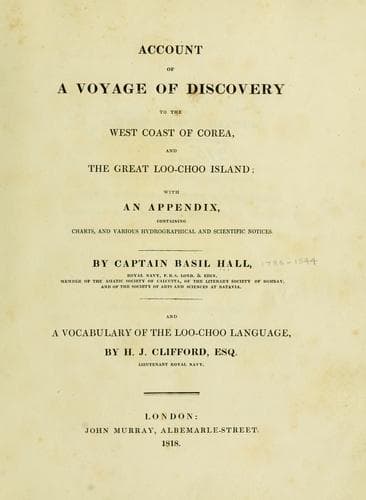
Account of a voyage of discovery to the west coast of Corea, and the great Loo-Choo IslandHall, Basil
History
Account of a voyage of discovery to the west coast of Corea, and the great Loo-Choo Island
Hall, Basil
Korea -- Description and travel; Ryukyu Islands -- Description and travel
The theory which presented itself to us on the spot was, that the lower
part of the great mass of strata which now forms the centre of the
island was formerly at the bottom of the ocean; and that the western
part, now a firm breccia, had been a beach of shingle produced by the
action of the waves on the upper strata, which may have formed a coast
above the sea: the granite of the eastern end of the island had been
forced into its present situation from beneath the strata, with
sufficient violence to dislocate and contort the beds nearest to it, and
to inject the liquid granite into the rents formed by the heaving action
of the strata as they were raised up. It is natural to suppose that the
ragged edges of the strata forming the sides of these cracks would be
subjected to a grinding action, from which the strata more remote might
be exempted; and in this way we may account for the extraordinary
twisting, and separation of masses along the whole course of the granite
dyke. In the dyke, as well as in the veins which branch from it, there
are numerous insulated portions of schistus. That this last was
softened, seems to follow from the frequent instances which occur of its
being bent back upon itself without producing cracks. The same heat,
generated by the melted granite in the neighbourhood, and which appears
to have been just sufficient to soften the schistus, may be supposed to
have reduced the shingle beach to a state of semi fusion by the aid of
some flux contained in the sand scattered amongst the fragments. We
could not discover any circumstance by which the relative antiquity of
the two dykes mentioned above could be inferred.
The junction of the granite and schistus above described, resembles very
much the well known junction at the Lowrin mountain, in Galloway,
described by my father, Sir James Hall, in the 7th vol. of the Edinburgh
Transactions. It is also very like the junctions at the Cape of Good
Hope, described in the same volume. The same theory has been found to
explain them all.
Specimen 7. Fine-grained granite, composed of white quartz, white
feldspar, and olive-green mica. This rock (7) forms the eastern end of
the island; the schistus next described (8) the centre, and the breccia
mentioned immediately afterwards (9) the western end.
8. Fine-grained compact micaceous schistus: some of the specimens appear
to contain plumbago. The strata lie north-west and south-east, dipping
only a few degrees from the horizontal line.
9. Breccia, composed of angular and contorted fragments of micaceous
schistus, and angular pieces of feldspar and quartz. This rock forms the
western end of Hutton's Island[24]: it rises in high rugged cliffs. The
angular pieces of schistus are of a similar rock to that described above
(8).
Public-domain text, read in full here on John Shaqi.
Reviews
Reviews
No reviews yet
Be the first to share your thoughts on this work.
Elsewhere in the archive
Join the Discussion
Join the discussion
Sign in to leave a comment or review.
Sign InorCreate an account