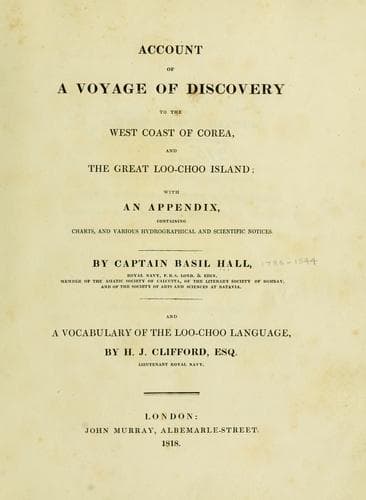
Account of a voyage of discovery to the west coast of Corea, and the great Loo-Choo IslandHall, Basil
History
Account of a voyage of discovery to the west coast of Corea, and the great Loo-Choo Island
Hall, Basil
Korea -- Description and travel; Ryukyu Islands -- Description and travel
There is little variety in the termination of the verb, the tenses being
expressed by other means. I have throughout the vocabulary considered
the termination _oong_ to denote the infinitive, and have translated it
as such, even when the sense points to another mood, merely to preserve
consistency; there are, however, a few exceptions to this, and some of
the verbs will be found to terminate in _ang_, _ing_, _awng_, _ong_, and
_ung_. Those ending in _oong_ seem generally to make the participle
terminate in _ee_, as _wockkayoong_, to separate, makes the participle
_wockkatee_, separated. The negative termination of the verb is
generally _nang_ or _rang_, as _noomang_, not to drink, is the negative
of _noomoong_, to drink; _meerang_, the negative of _meeoong_, to see;
and _nooboorang_, the negative of _noobooyoong_, to climb or ascend.
_Na_ is also used as a negative, _coonsoona_, not to rub out, being the
negative of _coonshoong_, to rub out.
_Nang_, _narang_, and _nashee_ are negatives used with a substantive,
and are always placed after it, as _koomoo nang_, no clouds; _meezee
narang_, no water; and _feejee nashee_, no beard.
Some peculiarities will be found by referring to the following words:
deaf; the sole of the foot; head-ache; palm of the hand; the toe; and
the wrist.
PART I.
VOCABULARY OF ENGLISH AND LOO-CHOO WORDS ALPHABETICALLY ARRANGED, WITH
NOTES, AND OCCASIONAL REFERENCES TO THE SENTENCES IN THE SECOND PART.
VOCABULARY
OF THE
LOO-CHOO LANGUAGE.
Note on the orthography used in the following vocabulary.--The sounds in
the Loo-Choo words are expressed by the letters which in English
correspond nearest to those sounds. There are no mute vowels. The letter
_a_ is invariably sounded as in the English word _far_. The emphasis is
marked by an accent over the last vowel of the accented syllable. _Ee_
and _oo_, whether accented or not, always express one syllable.
_English._ _Loo-Choo._
Public-domain text, read in full here on John Shaqi.
Reviews
Reviews
No reviews yet
Be the first to share your thoughts on this work.
Elsewhere in the archive
Join the Discussion
Join the discussion
Sign in to leave a comment or review.
Sign InorCreate an account