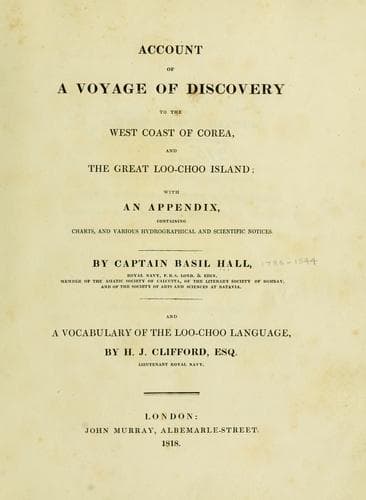
Account of a voyage of discovery to the west coast of Corea, and the great Loo-Choo IslandHall, Basil
History
Account of a voyage of discovery to the west coast of Corea, and the great Loo-Choo Island
Hall, Basil
Korea -- Description and travel; Ryukyu Islands -- Description and travel
The variety of coralines which girt the shores of this island was very
great, and large collections were made, as well of these as of the
numerous zoophites which filled up every part of the reefs below
high-water mark. This collection, of which unfortunately no duplicates
were kept, was afterwards lost.
SULPHUR ISLAND
Lies in latitude 27º 5' north, and longitude 128º 25' east. An accurate
representation of it is given as a frontispiece.
We attempted to land, but the surf broke every where so high against the
rock that this was impossible. There is a crater on the left side with
white smoke issuing from it; this has a strong sulphuric smell. The
sides of the crater are stratified. The south end of the island is about
four or five hundred feet high, and is formed of a dark dingy red rock
distinctly stratified; at several places it is cut vertically by great
dykes, which being more durable than the strata which they intersect,
stand out from the face of the cliffs to a considerable distance.
FOOTNOTES:
[Footnote 19: Specimen 7, infra.]
[Footnote 20: Specimen 8.]
[Footnote 21: Specimen 10.]
[Footnote 22: Specimen 11, infra.]
[Footnote 23: Specimen 9.]
[Footnote 24: The island above described was so named by Captain
Maxwell, in compliment to the memory of the distinguished philosopher
whose theory has been used to explain the curious phenomena which it
exhibits.]
END OF THE APPENDIX.
VOCABULARY OF THE LANGUAGE
SPOKEN AT
THE GREAT LOO-CHOO ISLAND, IN THE
JAPAN SEA.
COMPILED BY
HERBERT JOHN CLIFFORD, ESQ.
LIEUTENANT, ROYAL NAVY.
IN TWO PARTS.
OBSERVATIONS
ON
THE LOO-CHOO LANGUAGE.
Of the grammar of this language I pretend to little knowledge, but the
following observations upon some points may perhaps be worth attending
to. The most striking circumstance, is the frequent use of the words
_noo_ and _ka_; the former of which seems to signify _of_, or the _'s_
of the English language, as will appear in _choo noo ka_, a man's skin,
or the skin of a man; _ooshee noo stinnoo_, the bullock's horn, or the
horn of the bullock; and in _moo noo kee saw'teeyoong_, to dig potatoes
out of the ground, or, literally, potatoes of the earth to dig out.
_Ka_, it will be observed, is used to denote skin, and also seems to
signify a receiver or enclosure, as is expressed in the words _meezee
ka_, a well of water, _meezee_ being water, and _ka_, the place
containing the water; and in _ya ka saut eechoong_, to go out of a
place, _ka_ in this instance expressing the enclosure, _ya_ you, and
_sawt eechoong_ to go out from, as _eechoong_ signifies to go.
The adjective is for the most part placed before the substantive, as
_teeshooee ickkeega_, an old man; _wusa ya_, a mean house; and _wockka
innago_, a young woman.
Public-domain text, read in full here on John Shaqi.
Reviews
Reviews
No reviews yet
Be the first to share your thoughts on this work.
Elsewhere in the archive
Join the Discussion
Join the discussion
Sign in to leave a comment or review.
Sign InorCreate an account