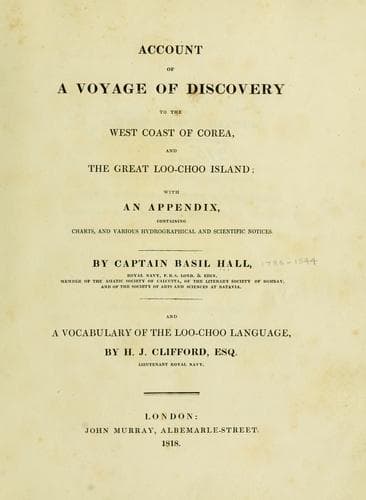
Account of a voyage of discovery to the west coast of Corea, and the great Loo-Choo IslandHall, Basil
History
Account of a voyage of discovery to the west coast of Corea, and the great Loo-Choo Island
Hall, Basil
Korea -- Description and travel; Ryukyu Islands -- Description and travel
[Footnote 34: This word signifies both a cask and a candlestick.]
[Footnote 35: See Sentence No. 70.]
[Footnote 36: _Noo_ seems to express _of_, or the _'s_ used in the
English language: as _Ooshee noo chee_, the cow's milk, or the milk of
the cow; _Ooshee noo ka_, the bullock's skin, or the skin of the
bullock; _Doochoo noo choe_, Loo-choo's people, or the people of
Loo-choo; and will be found in a variety of other instances.]
[Footnote 37: See Sentences Nos. 18, 19, and 21.]
[Footnote 38: The compass was generally called _Kassee tooee_, which two
words signify wind and a cock or fowl; but the landsmen called it
_Karahigh_, which signifies a watch.]
[Footnote 39: This is probably _Oowhoko_, signifying a great many
persons.]
[Footnote 40: The day at Loo-Choo is divided into six hours, as also the
night. In counting a number of days they apply the numerals in a similar
manner to that which will be found in a note on _Twitchee_, an hour; but
they did not seem to have any names to denote the days of the week.]
[Footnote 41: This word is generally used by the master of the house
when his guest announces his intended departure, by saying, _Cung,
cung_.]
[Footnote 42: See Sentences Nos. 74 and 76.]
[Footnote 43: See Sentences Nos. 29, 32, 33, and 37.]
[Footnote 44: See Sentences Nos. 24 and 107.]
[Footnote 45: See Sentences Nos. 31, 36, and 27.]
[Footnote 46: See Numerals, Loo-Choo and Japan, Part II. after the
Sentences.]
[Footnote 47: This word, which is composed of _addee_, this, and
_coodee_, that, I am not positive of, and I have therefore affixed a
query against it.]
[Footnote 48: This is a very difficult word to pronounce, and I am not
certain of having conveyed its true sound.]
[Footnote 49: See Sentence No. 111.]
[Footnote 50: See Sentence No. 55.]
[Footnote 51: See Sentence No. 20.]
[Footnote 52: See note on Numerals.]
[Footnote 53: The nearest sound to that of _flail_ which a native of
Loo-Choo could utter was that of _Freyroo_; generally speaking they
found great difficulty in pronouncing English words. The nearest sound
to that of our _l_ was _Airoo_, and to that of _vil_ was _Bayroo_.]
[Footnote 54: See note on Numerals.]
[Footnote 55: See Sentences Nos. 45, 47, and 48.]
[Footnote 56: The intention of departing from a house is generally
announced by _Cung, cung_.]
[Footnote 57: The hair of the natives is formed into a knot on the crown
of the head, and fastened by two pins of silver or brass, the one
ornamented by a flowered head, called _kamma-shishee_, and the other
_ooshee-thushee_. That worn by the children is called _jeefa_.]
[Footnote 58: This word is used to denote a _tree_ as well as a _hand_;
this probably arises from the similarity; considering the _hand_ as the
trunk, and the fingers the branches of the _tree_.]
Public-domain text, read in full here on John Shaqi.
Reviews
Reviews
No reviews yet
Be the first to share your thoughts on this work.
Elsewhere in the archive
Join the Discussion
Join the discussion
Sign in to leave a comment or review.
Sign InorCreate an account