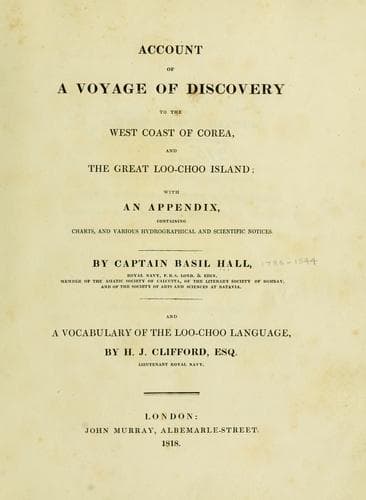
Account of a voyage of discovery to the west coast of Corea, and the great Loo-Choo IslandHall, Basil
History
Account of a voyage of discovery to the west coast of Corea, and the great Loo-Choo Island
Hall, Basil
Korea -- Description and travel; Ryukyu Islands -- Description and travel
[Footnote 59: A piece of China crape, or very fine paper, is used as a
handkerchief by the superior classes of the natives, and is generally
worn in the bosom: the lower orders substitute a coarser kind of paper.]
[Footnote 60: A negative in frequent use.]
[Footnote 61: This word may be applied to being in want of water.]
[Footnote 62: See Sentence No. 2.]
[Footnote 63: A strong aspirate.]
[Footnote 64: See note on _I_ or _me_ (first person) next page.]
[Footnote 65: These two expressions were obtained by catching a
butterfly and then letting it go.]
[Footnote 66: The _jeeshee_, or _vase_, is a stone jar in which the
bones of the dead are deposited at the expiration of seven years after
burial.]
[Footnote 67: The same word (_obee_) signifies both the hoop of a cask
and the girdle worn round the waist; this probably originated in the
girdle being substituted for the hoop, which appears to have been worn
formerly.]
[Footnote 68: _Ma_, signifying a horse, is a Chinese word, and was
probably introduced into Loo-Choo with that animal.]
[Footnote 69: The names of the hours will be found in the second part;
the divisions of time will be found under their different heads of
day, month, year, &c.]
[Footnote 70: While seeking to obtain from the natives the pronouns _I_,
_you_, and _him_, I at first got _chooee, lay_, and _meechay;_ but on
further enquiry I found that these had not that meaning, they were
superseded by _wang_, _ya_, and _aree_, for _I_, _you_, and _him;_ but
as I heard _chooee_, _lay_, and _meechay_ repeated in enumerating
persons, I have set them down as first, second, and third persons, that
being the sense which they seem to bear. The word _chooee_, or _choo_,
it would seem signifies man (homo) in a general sense.]
[Footnote 71: See Sentence No. 96.]
[Footnote 72: See Sentence No. 99.]
[Footnote 73: See Sentence No. 101.]
[Footnote 74: See Sentence No. 6.]
[Footnote 75: See note, "Holding a thing."]
[Footnote 76: See Sentences Nos. 81 and 82.]
[Footnote 77: See Sentences Nos. 38 to 44.]
[Footnote 78: Literally to sew clothes.]
[Footnote 79: Literally to work rope.]
[Footnote 80: _Skoyoong_, or _Sookooyoong_, signifies to bake.]
[Footnote 81: This word, which is composed of _ickkee_ and _ya_
(_ickkee_ signifying _there_, and _ga_, which may possibly have been
originally _ya, you_), appeared to me to bear a similar meaning to our
_you, sir_, or _you, there_, as the natives invariably called out
_ickkeega_, when wishing to attract the attention of any one.]
[Footnote 82: See note on the _kawroo_. The _kaw_ is also burned when an
offering of rice is made on the _kawroo_.]
[Footnote 83: The following are the names of the months or moons.
Public-domain text, read in full here on John Shaqi.
Reviews
Reviews
No reviews yet
Be the first to share your thoughts on this work.
Elsewhere in the archive
Join the Discussion
Join the discussion
Sign in to leave a comment or review.
Sign InorCreate an account