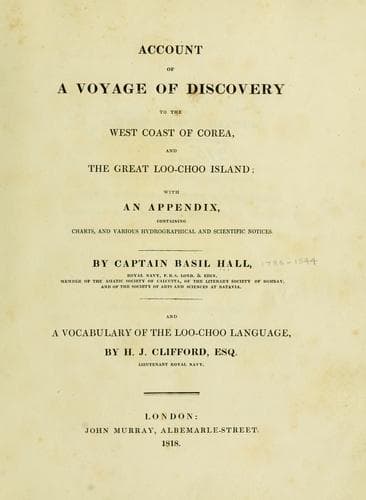
Account of a voyage of discovery to the west coast of Corea, and the great Loo-Choo IslandHall, Basil
History
Account of a voyage of discovery to the west coast of Corea, and the great Loo-Choo Island
Hall, Basil
Korea -- Description and travel; Ryukyu Islands -- Description and travel
In a square flat place near the village a number of women and children
were employed winnowing corn by pouring it from a height, so that the
husks blew away. Fishing-nets were spread to dry on most of the houses.
We landed about five o'clock, and found in the village only two men, who
obstinately remained at one place without speaking, and looking anxious
that we should go away; they refused the buttons which we offered them,
and resisted our persuasions to accompany us to the upper part of the
village, which we were anxious they should do, to shew that we had no
intention of hurting any thing, but merely to look about us. We went on
alone, and on reaching a deserted house thought it a good opportunity to
examine it. Before the door, on a neat clean level space, enclosed by a
hedge covered with a sweet-scented white flower, we found several heaps
of corn and straw, and several of the wooden mortars in which the rice
is pounded, also a number of vessels, some filled with water and others
with rice. Cooking utensils were lying about, and a number of fishing
lines coiled neatly in baskets, and split fish spread out to dry on the
top of little corn ricks on one side of the court. The inside was dark
and uncomfortable; the mud floor was full of hollow places; the walls
were black with soot, and every thing looked dirty. On the left of the
entrance two large metal boilers, twenty inches deep, were sunk in the
brickwork, the upper part being about a foot above the floor. The
fire-place was between the boilers, and on the hot embers lay three
split fish. On the wall opposite to the fire were shelves, having a
number of cups, basons, and cooking utensils, principally of coarse
stone ware, and some few of a sort of bell-metal. The number of
inhabitants in one house must be considerable, if we can form an
estimate from the quantity of their dishes and vessels. There were three
neat small pieces of furniture on one of the shelves, the use of which
we could not discover; they were made of wood, elegantly carved and
varnished, with a round top about a foot in diameter, and four legs a
foot and a half long. The roof was well constructed, the rafters being
mortised into the ends of the horizontal beams, and tied to the middle
by a perpendicular beam or King-Post. Over the rafters is laid a
net-work of rods, to which the thatch is tied. There was no chimney to
this house, and only one window made of slender bars of wood, forming
square spaces three inches by two, covered by a thin semi-transparent
paper defended by the roof, which extends so far beyond the wall as to
shelter it not only from the rain but from the sun. Most of the houses
had a sort of raised verandah under the eaves, about a foot or more
above the ground, extending from the door on either hand to the end of
the house; these places were neatly levelled, and must afford a cool
seat. The walls of the houses are from six to eight feet high, and from
Public-domain text, read in full here on John Shaqi.
Reviews
Reviews
No reviews yet
Be the first to share your thoughts on this work.
Join the Discussion
Join the discussion
Sign in to leave a comment or review.
Sign InorCreate an account