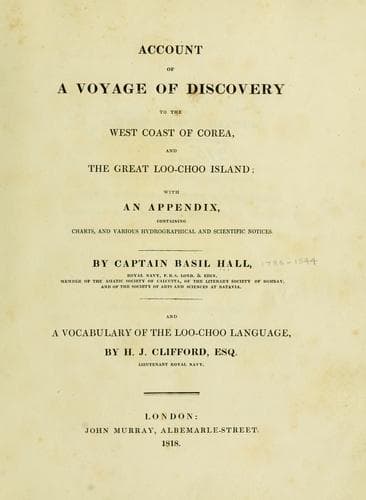
Account of a voyage of discovery to the west coast of Corea, and the great Loo-Choo Island — John Shaqi
Account of a voyage of discovery to the west coast of Corea, and the great Loo-Choo IslandHall, Basil
History
Account of a voyage of discovery to the west coast of Corea, and the great Loo-Choo Island
Hall, Basil
Korea -- Description and travel; Ryukyu Islands -- Description and travel
The theory which presented itself to us on the spot was, that the great
mass of strata which forms the centre of the island was formerly at the
bottom of the ocean; and that the western part, which is now a firm
breccia, had been a beach shingle produced by the action of the waves on
the strata: the granite which forms the eastern end of the island had
been forced into its present situation from beneath the strata, with
sufficient violence to dislocate and contort the beds nearest to it, and
to inject the liquid granite into the rents formed by the heaving action
of the strata as they were raised up. It is natural to suppose that the
ragged edges of the strata forming the sides of these cracks would be
subjected to a grinding action, from which the strata more remote might
be exempted; and in this way we may account for the extraordinary
twisting, and separation of masses along the whole course of the granite
dyke. In the dyke, as well as in the veins which branch from it, there
are numerous islands of schistus. That this last was softened, seems to
follow from the frequent instances which occur of its being bent back
upon itself without producing cracks. The same heat, propagated by the
melted granite in the neighbourhood, may also be supposed to have
reduced the shingle beach to a state of semifusion by the aid of some
flux contained in the sand scattered amongst it. We could not discover
any circumstance by which the relative antiquity of the two dykes
mentioned above, could be ascertained.]
[Footnote 3: _Note on the peculiar character of the written language in
that quarter of the globe._
In China, Japan, Corea, and the islands in the adjacent seas, the spoken
languages are different from one another; the written language, on the
contrary, is the same in all. Thus a native of China is unintelligible
to a Corean or Japanese, while he is speaking, but they mutually
understand one another when their thoughts are expressed in writing. The
cause of this may be thus explained. We in Europe form an idea in the
mind, and this we express by certain sounds, which differ in different
countries; these sounds are committed to writing by means of the letters
of the alphabet, which are only symbols of sounds, and, consequently, a
writing in Europe is unintelligible to every one who is ignorant of the
spoken language in which it happens to be written. The Chinese and the
other natives in these seas have, on the contrary, no alphabet; no
symbols of sounds; their ideas are committed to writing at once without
the intervention of sound, and their characters may therefore be called
symbols of ideas. Now, as the same characters are adopted in all these
countries to express the same ideas, it is clear that their writings
will be perfectly intelligible to each other, although their spoken
languages may be quite incomprehensible.
Public-domain text, read in full here on John Shaqi.
Reviews
Reviews
No reviews yet
Be the first to share your thoughts on this work.
Join the Discussion
Join the discussion
Sign in to leave a comment or review.
Sign InorCreate an account