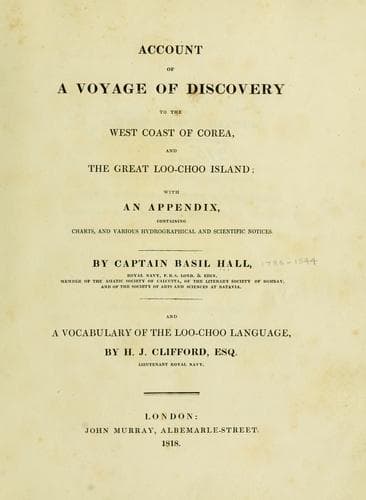
Account of a voyage of discovery to the west coast of Corea, and the great Loo-Choo IslandHall, Basil
History
Account of a voyage of discovery to the west coast of Corea, and the great Loo-Choo Island
Hall, Basil
Korea -- Description and travel; Ryukyu Islands -- Description and travel
After leaving Corea, we stood to the southward and eastward, with a
strong breeze from the north, and a mountainous swell from the
north-east. Shortly after daybreak on the 13th of September, we saw
Sulphur Island, in the south-west quarter, and by eleven in the forenoon
were close up to it. We intended to land, but were prevented by the high
wind, which caused so great a surf all round the island, as to render
this impracticable. The sulphuric volcano from which the island takes
its name is on the north-west side; it emits white smoke, and the smell
of sulphur is very strong on the lee side of the crater. The cliffs
near the volcano are of a pale yellow colour, interspersed with brown
streaks: the ground at this place is very rugged, as the strata lie in
all directions, and are much broken; on the top is a thin coat of brown
grass. The south end of the island is of considerable height, of a deep
blood red colour, with here and there a spot of bright green: the
strata, which are here nearly horizontal, are cut by a whin dyke running
from the top to the bottom of the cliff, projecting from its face like a
wall. As the weather still looked threatening, we gave up the intention
of examining this spot, and proceeded to the southward till four
o'clock, at which time land was seen in the south-west quarter; but as
there was not sufficient daylight to close with it, we hauled off to the
westward for the night. Shortly after sunset the sky became overcast,
the wind veered about from one point to another, the air became suddenly
quite chill, the sea rose high, and every thing, in short, seemed to
indicate an approaching tyfoong or hurricane. All our preparations were
made to encounter a violent tempest; but we were much pleased at finding
it turn out nothing more than an ordinary gale of wind.
Public-domain text, read in full here on John Shaqi.
Reviews
Reviews
No reviews yet
Be the first to share your thoughts on this work.
Join the Discussion
Join the discussion
Sign in to leave a comment or review.
Sign InorCreate an account