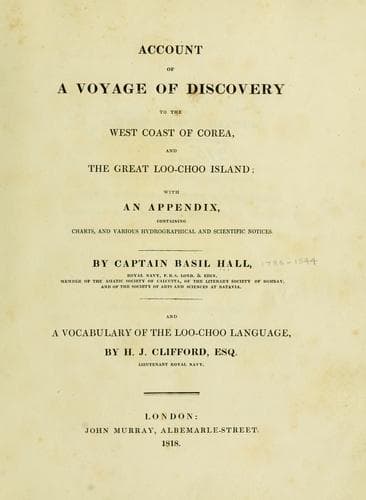
Account of a voyage of discovery to the west coast of Corea, and the great Loo-Choo Island — John Shaqi
Account of a voyage of discovery to the west coast of Corea, and the great Loo-Choo IslandHall, Basil
History
Account of a voyage of discovery to the west coast of Corea, and the great Loo-Choo Island
Hall, Basil
Korea -- Description and travel; Ryukyu Islands -- Description and travel
During all this morning, the whole space between the ships and the shore
has been covered with canoes, each containing about ten persons. The
scene was very lively, for few of the parties which came to visit the
ships remained long on board, so that the canoes were continually
passing backwards and forwards, and the number which came in this way
must have been immense. They all seemed highly gratified at being
allowed to go wherever they liked over the ships, nor was this liberty
ever abused. The manners even of the lowest classes are genteel and
becoming; their curiosity is great, but it never makes them rudely
inquisitive: their language is musical, and in most cases easy of
pronunciation. We heard a boat song to-day, the air of which was sweet
and plaintive; we tried in vain to catch the words, and unfortunately,
none of us had skill enough to note down the air. We observed several
people in canoes, making drawings of the ships, but they hid their work
when they were observed. In consequence of what had been said last night
of our wanting repairs, a party of shipwrights and caulkers was sent on
board the Alceste this morning, but their tools were of a Lilliputian
order, and quite unsuited to the rough work required.
The variety of colour and pattern in the dresses of the people to-day,
is remarkable. Many wear printed cottons, others have cotton dresses
with the pattern drawn on it by hand, instead of being stamped; but
blue, in all its shades, is the prevalent colour, though there were many
dresses resembling in every respect Highland tartans. The children, in
general, wear more shewy dresses than the men, and of the dress of the
women we can say nothing, as none have yet been seen. Every person has
one of the girdles before described, which is always of a different
colour from the dress, and is, in general, richly ornamented with
flowers in embossed silk, and sometimes with gold and silver threads.
This dress is naturally so graceful, that even the lowest boatmen have
a picturesque appearance. Their hair, which is of a glossy black, is
shaved off the crown, but the bare place is concealed by their mode of
dressing the hair in a close knot over it. Their beards and mustachios
are allowed to grow, and are kept neat and smooth. They are rather low
in stature, but are well formed, and have an easy graceful carriage,
which suits well with their flowing dress. Their colour is not good,
some being very dark and others nearly white, but in most instances they
are of a deep copper. This is fully compensated for by the sweetness and
intelligence of their countenance. Their eyes, which are black, have a
placid expression, and their teeth are regular and beautifully white. In
deportment they are modest, polite, timid, and respectful, and in short,
appear to be a most interesting and amiable people.
Public-domain text, read in full here on John Shaqi.
Reviews
Reviews
No reviews yet
Be the first to share your thoughts on this work.
Join the Discussion
Join the discussion
Sign in to leave a comment or review.
Sign InorCreate an account