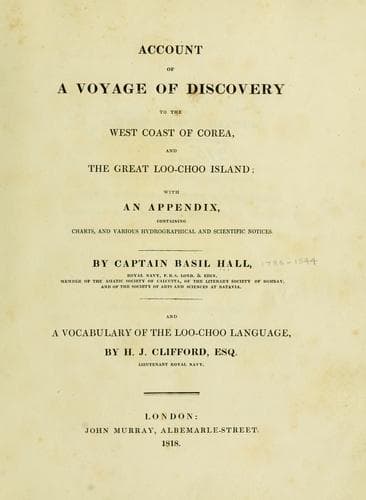
Account of a voyage of discovery to the west coast of Corea, and the great Loo-Choo IslandHall, Basil
History
Account of a voyage of discovery to the west coast of Corea, and the great Loo-Choo Island
Hall, Basil
Korea -- Description and travel; Ryukyu Islands -- Description and travel
On rising from breakfast we found, near the tent, about a dozen natives,
who, in most respects, resembled our friends at Napakiang, but were not
so neatly dressed; and their hair, instead of being formed into a knot,
was allowed to fly loose. During the morning the party amused themselves
in various ways. Some took their guns and went in search of curlews and
sea-snipes: others set out to explore the reefs; and two or three
remained near the tent, for the purpose of making observations on the
sun at noon; but as it became cloudy about this time, the latter party
failed in their object. The rest were more successful; the sportsmen
having shot some game for dinner; and the other party having found all
things favourable for inspecting the reef.
The examination of a coral reef during the different stages of one
tide, is particularly interesting. When the tide has left it for some
time it becomes dry, and appears to be a compact rock, exceedingly hard
and ragged; but as the tide rises, and the waves begin to wash over it,
the coral worms protrude themselves from holes which were before
invisible. These animals are of a great variety of shapes and sizes, and
in such prodigious numbers, that, in a short time, the whole surface of
the rock appears to be alive and in motion. The most common worm is in
the form of a star, with arms from four to six inches long, which are
moved about with a rapid motion in all directions, probably to catch
food. Others are so sluggish, that they may be mistaken for pieces of
the rock, and are generally of a dark colour, and from four to five
inches long, and two or three round. When the coral is broken, about
high water mark, it is a solid hard stone, but if any part of it be
detached at a spot which the tide reaches every day, it is found to be
full of worms of different lengths and colours, some being as fine as a
thread and several feet long, of a bright yellow, and sometimes of a
blue colour: others resemble snails, and some are not unlike lobsters in
shape, but soft, and not above two inches long[10].
Public-domain text, read in full here on John Shaqi.
Reviews
Reviews
No reviews yet
Be the first to share your thoughts on this work.
Elsewhere in the archive
Join the Discussion
Join the discussion
Sign in to leave a comment or review.
Sign InorCreate an account