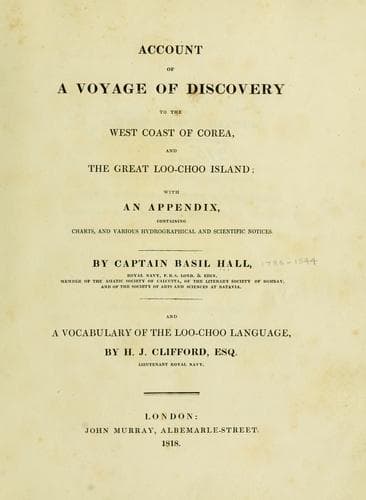
Account of a voyage of discovery to the west coast of Corea, and the great Loo-Choo IslandHall, Basil
History
Account of a voyage of discovery to the west coast of Corea, and the great Loo-Choo Island
Hall, Basil
Korea -- Description and travel; Ryukyu Islands -- Description and travel
The growth of coral appears to cease when the worm is no longer exposed
to the washing of the sea. Thus, a reef rises in the form of a
cauliflower, till its top has gained the level of the highest tides,
above which the worm has no power to advance, and the reef of course no
longer extends itself upwards. The other parts, in succession, reach the
surface, and there stop, forming in time a level field with steep sides
all round. The reef, however, continually increases, and being prevented
from going higher, extends itself laterally in all directions. But this
growth being as rapid at the upper edge as it is lower down, the
steepness of the face of the reef is still preserved. These are the
circumstances which render coral reefs so dangerous in navigation; for,
in the first place, they are seldom seen above the water; and, in the
next, their sides are so steep, that a ship's bows may strike against
the rock before any change of soundings has given warning of the danger.
The island at high water is formed into three parts, which at low water
are joined by reefs; the whole being about two and a half or three miles
from east to west, and tolerably clear of rocks on the south side; but
on the north it is guarded by a semicircle of coral extending upwards of
a mile from the shore. On the centre island is only one hut, which, as
there was reason to believe it to be the actual abode of the
inhabitants, it may be allowable to describe. The walls were sunk under
ground, so that only the roof appeared from without, the inside was
fifteen feet by six: the walls of neatly squared stones, being two feet
high, and the roof in the middle about six or seven high, formed of a
ridge pole supported in the centre by a forked stick; the rafters of
rough branches were covered with reeds, and thatched over with the leaf
of the wild pine, which grows on all the coral islands. The fire-place
was at one end on a raised part of the floor, and the other end appeared
to be the sleeping place. It was conjectured, that this wretched place
could only be meant as a temporary residence of fishermen, whose nets we
saw lying about; but the number of water jars and cooking utensils which
we found in and about it, gave it the appearance of a fixed habitation.
It was almost dark when we quitted the island, and the tide carrying us
out of our proper course, we missed the ships and grounded on the reefs
near the town; but as the tide was flowing, we easily got off, and by
coasting along, soon gained the anchorage.
Sunday, 29th of September.--This day is memorable, on account of its
being the first on which we were permitted to land.
Public-domain text, read in full here on John Shaqi.
Reviews
Reviews
No reviews yet
Be the first to share your thoughts on this work.
Elsewhere in the archive
Join the Discussion
Join the discussion
Sign in to leave a comment or review.
Sign InorCreate an account