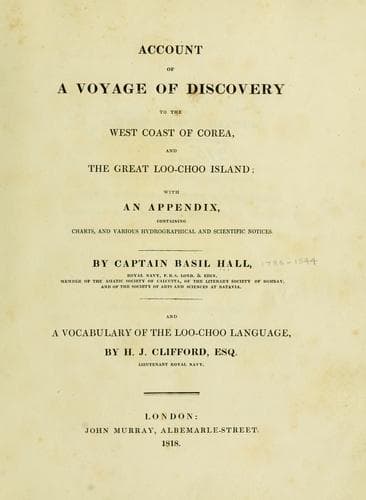
Account of a voyage of discovery to the west coast of Corea, and the great Loo-Choo IslandHall, Basil
History
Account of a voyage of discovery to the west coast of Corea, and the great Loo-Choo Island
Hall, Basil
Korea -- Description and travel; Ryukyu Islands -- Description and travel
Two of the natives have been studying English with great assiduity, and
with considerable success. One is called Madera, the other Anya. They
carry note books in imitation of Mr. Clifford, in which they record in
their own characters every word they learn. They are both keen fellows,
and are always amongst the strangers. From the respect occasionally paid
to them, it is suspected that their rank is higher than they give out,
and that their object in pretending to be people of ordinary rank, is to
obtain a more free intercourse with all classes on board the ships.
Madera, by his liveliness and his propriety of manners, has made himself
a great favourite; he adopts our customs with a sort of intuitive
readiness, sits down to table, uses a knife and fork, converses, and
walks with us, in short, does every thing that we do, quite as a matter
of course, without any apparent effort or study. He is further
recommended to us by the free way in which he communicates every thing
relating to his country; so that as he advances in English, and we in
Loo-choo, he may be the means of giving us much information. As an
instance of his progress in English, it may be mentioned, that one day
he came on board the Lyra, and said, "The Ta-yin speak me, 'you go ship,
John come shore;'" by which we understood that Captain Maxwell had sent
him on board the brig for the interpreter. This was about three weeks
after our arrival.
[Illustration: PRIEST and GENTLEMAN of LOO-CHOO.]
Most of the natives have acquired a little English, so that Mr. Clifford
has now no difficulty in finding people willing to instruct him, and to
take pains in correcting his pronunciation. One of his teachers, called
Yackabee Oomeejeero, will not permit him to write down a single word
till he has acquired the exact Loo-choo sound: but he is like the rest
in shewing an invincible objection to giving any information about the
women. He admits that he is married, and gives the names of his sons:
but when his wife or daughters are alluded to, he becomes uneasy, and
changes the subject. On Mr. Clifford's gravely telling him that he
believed there were no women on the island, he was thrown off his guard,
and answered hastily, that he had both a wife and daughter, but
instantly checking himself, turned the conversation another way. On the
picture of an English lady being shewn to him, he commended it highly,
saying, at the same time, "Doochoo innago whooco oorung" (Loo-choo
women are not handsome.) This old gentleman is a better teacher than
scholar; he calls the letter L "airoo;" veal, "bairoo;" flail,
"frayroo;" in which instances of mispronunciation, we may recognize a
difficulty not uncommon amongst English children.
FOOTNOTES:
[Footnote 6: This circumstance is by no means common, and therefore
cannot be depended on. In fine weather these reefs give no warning
whatever, and a ship on approaching them ought invariably to have a boat
a-head.]
Public-domain text, read in full here on John Shaqi.
Reviews
Reviews
No reviews yet
Be the first to share your thoughts on this work.
Elsewhere in the archive
Join the Discussion
Join the discussion
Sign in to leave a comment or review.
Sign InorCreate an account