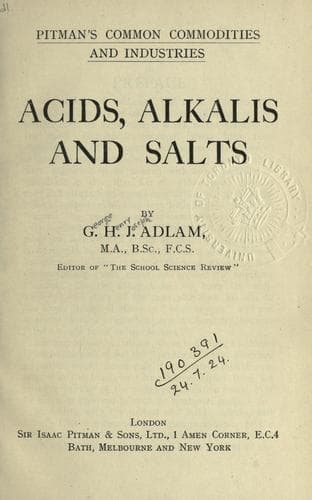
Acids, Alkalis and SaltsAdlam, George Henry Joseph
Science
Acids, Alkalis and Salts
Adlam, George Henry Joseph
Acids; Alkalies; Salts
COMMON COMMODITIES AND INDUSTRIES SERIES
Each book in crown 8vo, cloth, with many illustrations, charts, etc.,
2/6 net
TEA. By A. Ibbetson
COFFEE. By B. B. Keable
SUGAR. By Geo. Martineau, C.B.
OILS. By C. Ainsworth Mitchell, B.A., F.I.C.
WHEAT. By Andrew Millar
RUBBER. By C. Beadle and H. P. Stevens, M.A., Ph.D., F.I.C.
IRON AND STEEL. By C. Hood
COPPER. By H. K. Picard
COAL. By Francis H. Wilson, M.Inst., M.E.
TIMBER. By W. Bullock
COTTON. By R. J. Peake
SILK. By Luther Hooper
WOOL. By J. A. Hunter
LINEN. By Alfred S. Moore
TOBACCO. By A. E. Tanner
LEATHER. By K. J. Adcock
KNITTED FABRICS. By J. Chamberlain and J. H. Quilter
CLAYS. By Alfred B. Searle
PAPER. By Harry A. Maddox
SOAP. By William A. Simmons, B.Sc. (Lond.), F.C.S.
THE MOTOR INDUSTRY. By Horace Wyatt, B.A.
GLASS AND GLASS MAKING. By Percival Marson
GUMS AND RESINS. By E. J. Parry, B.Sc., F.I.C., F.C.S.
THE BOOT AND SHOE INDUSTRY. By J. S. Harding
GAS AND GAS MAKING. By W. H. Y. Webber
FURNITURE. By H. E. Binstead
COAL TAR. By A. R. Warnes
PETROLEUM. By A. Lidgett
SALT. By A. F. Calvert
ZINC. By T. E. Lones, M.A., LL.D., B.Sc.
PHOTOGRAPHY. By Wm. Gamble
ASBESTOS. By A. Leonard Summers
SILVER. By Benjamin White
CARPETS. By Reginald S. Brinton
PAINTS AND VARNISHES. By A. S. Jennings
CORDAGE AND CORDAGE HEMP AND FIBRES. By T. Woodhouse and P. Kilgour
ACIDS AND ALKALIS. By G. H. J. Adlam
_OTHERS IN PREPARATION_
[Illustration: _Copyright by Messrs Flatters & Garnett, Manchester_
BACTERIA NODULES ON THE ROOT OF LUPIN]
PITMAN’S COMMON COMMODITIES AND INDUSTRIES
ACIDS, ALKALIS AND SALTS
BY
G. H. J. ADLAM,
M.A., B.Sc., F.C.S.
Editor of “The School Science Review”
London
Sir Isaac Pitman & Sons, Ltd., 1 Amen Corner, E.C.4
Bath, Melbourne and New York
Printed by Sir Isaac Pitman & Sons, Ltd., London, Bath, Melbourne and
New York
PREFACE
It has often been said, and still more often implied, that
considerations of utility in education are incompatible with its main
object, which is the training of the mind. Extremely divergent views
have been expressed on this point. Schoolmen have looked askance at some
branches of knowledge because they were supposed to be tainted with the
possibility of usefulness in after life. On the other hand, business men
and others have complained bitterly of the present state of education
because very little that is considered “useful” has up to the present
been taught in schools.
Public-domain text, read in full here on John Shaqi.
Reviews
Reviews
No reviews yet
Be the first to share your thoughts on this work.
Join the Discussion
Join the discussion
Sign in to leave a comment or review.
Sign InorCreate an account