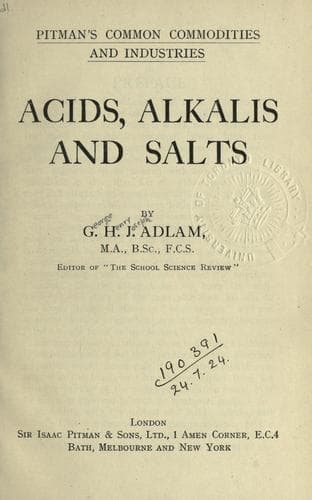
Acids, Alkalis and SaltsAdlam, George Henry Joseph
Science
Acids, Alkalis and Salts
Adlam, George Henry Joseph
Acids; Alkalies; Salts
Alkali Waste. Black ash contains less than half its weight of soda, so
that for every ton of soda produced there is from a ton and a half to
two tons of an insoluble residue which collects in the lixiviating and
settling tanks. This residue is known as alkali waste.
Alkali waste is of no particular value. It is not even suitable as a
dressing for the land, and since it is not soluble in water there is no
convenient means of disposing of it. Consequently, it is just
accumulated at the works and, as the heap grows at an alarming rate, it
cumbers much valuable ground. Moreover, it contains sulphides from
which, under the influence of air and moisture, sulphuretted hydrogen is
liberated. Alkali waste, therefore, has a very unpleasant odour.
The whole of the sulphur which was contained in the sulphuric acid used
in the first stage of the process remains in the alkali waste, mainly as
calcium sulphide. A plant for the recovery of this sulphur is
established in some of the larger works. The alkali waste is mixed with
water to the consistency of a thin cream, in tall, vertical cylinders.
Carbon dioxide under pressure is forced into the mixture, and this
converts the calcium sulphide into calcium carbonate and sets free
hydrogen sulphide, which, when burnt with a limited supply of air,
yields sulphur.
By this process, the most unpleasant feature of alkali waste, namely,
the smell, is removed. The calcium carbonate which remains is of very
little value. Some of it is used in making up fresh charges for the
black ash process and some for preparing Portland cement, for which
finely-ground calcium carbonate is required; the remainder is thrown on
a heap.
Bicarbonate of Soda. Bicarbonate of soda can be easily distinguished
from washing soda. It is a fine, white powder similar in appearance to
the efflorescence on soda crystals. It does not contain any water of
crystallization.
When bicarbonate of soda is heated, it does not melt, and, as far as its
external appearance is concerned, it does not seem to undergo any
change. If, however, suitable arrangements are made, water and carbon
dioxide gas can be collected, and the sodium bicarbonate will be found
to have lost 36·9 per cent. of its weight. The substance which remains
is identical with that obtained by heating soda crystals, that is,
anhydrous sodium carbonate. Sodium bicarbonate is, therefore, a compound
of sodium carbonate and carbonic acid.
Public-domain text, read in full here on John Shaqi.
Reviews
Reviews
No reviews yet
Be the first to share your thoughts on this work.
Join the Discussion
Join the discussion
Sign in to leave a comment or review.
Sign InorCreate an account