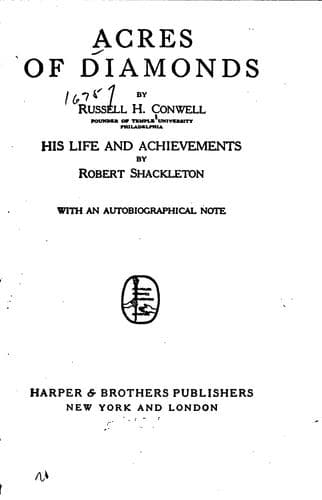
This stirring manifesto shows how to discover everything you need to succeed— where you least expect it.So begins one of the most famous speeches of the twentieth century, a talk that educator and minister Russell H. Conwell delivered before literally thousands of audiences before his death in 1925. In its printed version Acres of Diamonds reached millions of readers around the world. Conwell's great manifesto imparts one extraordinary lesson: All the wealth you could ever dream of, search for, or yearn after—in whatever form you wish for—exists right beneath your own feet. It is a message of determination, unconventional thinking, and positive living that came to influence a generation of motivational literature.The Success Classics edition of Acres of Diamonds also features two rare bonus works: Praying for Money and The Story of "Acres of Diamonds" by journalist Robert Shackleton.
I have read in the newspaper that a woman never invented anything.
Well, that newspaper ought to begin again. Of course, I do not refer
to gossip--I refer to machines--and if I did I might better include
the men. That newspaper could never appear if women had not invented
something. Friends, think. Ye women, think! You say you cannot make a
fortune because you are in some laundry, or running a sewing-machine, it
may be, or walking before some loom, and yet you can be a millionaire if
you will but follow this almost infallible direction.
When you say a woman doesn’t invent anything, I ask, Who invented
the Jacquard loom that wove every stitch you wear? Mrs. Jacquard. The
printer’s roller, the printing-press, were invented by farmers’ wives.
Who invented the cotton-gin of the South that enriched our country so
amazingly? Mrs. General Greene invented the cotton-gin and showed the
idea to Mr. Whitney, and he, like a man, seized it. Who was it that
invented the sewing-machine? If I would go to school to-morrow and ask
your children they would say, “Elias Howe.”
He was in the Civil War with me, and often in my tent, and I often heard
him say that he worked fourteen years to get up that sewing-machine.
But his wife made up her mind one day that they would starve to death
if there wasn’t something or other invented pretty soon, and so in two
hours she invented the sewing-machine. Of course he took out the patent
in his name. Men always do that. Who was it that invented the mower and
the reaper? According to Mr. McCormick’s confidential communication, so
recently published, it was a West Virginia woman, who, after his father
and he had failed altogether in making a reaper and gave it up, took a
lot of shears and nailed them together on the edge of a board, with one
shaft of each pair loose, and then wired them so that when she pulled
the wire one way it closed them, and when she pulled the wire the
other way it opened them, and there she had the principle of the
mowing-machine. If you look at a mowing-machine, you will see it is
nothing but a lot of shears. If a woman can invent a mowing-machine, if
a woman can invent a Jacquard loom, if a woman can invent a cotton-gin,
if a woman can invent a trolley switch--as she did and made the trolleys
possible; if a woman can invent, as Mr. Carnegie said, the great iron
squeezers that laid the foundation of all the steel millions of the
United States, “we men” can invent anything under the stars! I say that
for the encouragement of the men.
Public-domain text, read in full here on John Shaqi.
Reviews
Reviews
No reviews yet
Be the first to share your thoughts on this work.
Join the Discussion
Join the discussion
Sign in to leave a comment or review.
Sign InorCreate an account