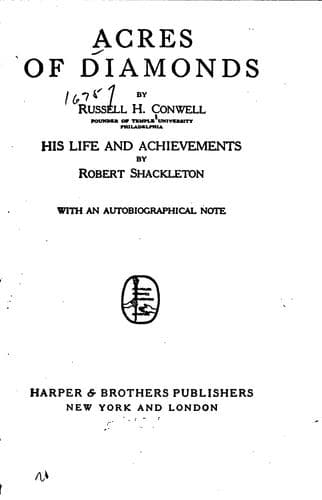
This stirring manifesto shows how to discover everything you need to succeed— where you least expect it.So begins one of the most famous speeches of the twentieth century, a talk that educator and minister Russell H. Conwell delivered before literally thousands of audiences before his death in 1925. In its printed version Acres of Diamonds reached millions of readers around the world. Conwell's great manifesto imparts one extraordinary lesson: All the wealth you could ever dream of, search for, or yearn after—in whatever form you wish for—exists right beneath your own feet. It is a message of determination, unconventional thinking, and positive living that came to influence a generation of motivational literature.The Success Classics edition of Acres of Diamonds also features two rare bonus works: Praying for Money and The Story of "Acres of Diamonds" by journalist Robert Shackleton.
Then he said to me, “How is it going in the field?” I said, “We
sometimes get discouraged.” And he said: “It is all right. We are going
to win out now. We are getting very near the light. No man ought to
wish to be President of the United States, and I will be glad when I get
through; then Tad and I are going out to Springfield, Illinois. I
have bought a farm out there and I don’t care if I again earn only
twenty-five cents a day. Tad has a mule team, and we are going to plant
onions.”
Then he asked me, “Were you brought up on a farm?” I said, “Yes; in the
Berkshire Hills of Massachusetts.” He then threw his leg over the corner
of the big chair and said, “I have heard many a time, ever since I was
young, that up there in those hills you have to sharpen the noses of the
sheep in order to get down to the grass between the rocks.” He was so
familiar, so everyday, so farmer-like, that I felt right at home with
him at once.
He then took hold of another roll of paper, and looked up at me and
said, “Good morning.” I took the hint then and got up and went out.
After I had gotten out I could not realize I had seen the President of
the United States at all. But a few days later, when still in the city,
I saw the crowd pass through the East Room by the coffin of Abraham
Lincoln, and when I looked at the upturned face of the murdered
President I felt then that the man I had seen such a short time before,
who, so simple a man, so plain a man, was one of the greatest men that
God ever raised up to lead a nation on to ultimate liberty. Yet he was
only “Old Abe” to his neighbors. When they had the second funeral, I was
invited among others, and went out to see that same coffin put back in
the tomb at Springfield. Around the tomb stood Lincoln’s old neighbors,
to whom he was just “Old Abe.” Of course that is all they would say.
Did you ever see a man who struts around altogether too large to notice
an ordinary working mechanic? Do you think he is great? He is nothing
but a puffed-up balloon, held down by his big feet. There is no
greatness there.
Who are the great men and women? My attention was called the other day
to the history of a very little thing that made the fortune of a very
poor man. It was an awful thing, and yet because of that experience
he--not a great inventor or genius--invented the pin that now is called
the safety-pin, and out of that safety-pin made the fortune of one of
the great aristocratic families of this nation.
Public-domain text, read in full here on John Shaqi.
Reviews
Reviews
No reviews yet
Be the first to share your thoughts on this work.
Join the Discussion
Join the discussion
Sign in to leave a comment or review.
Sign InorCreate an account