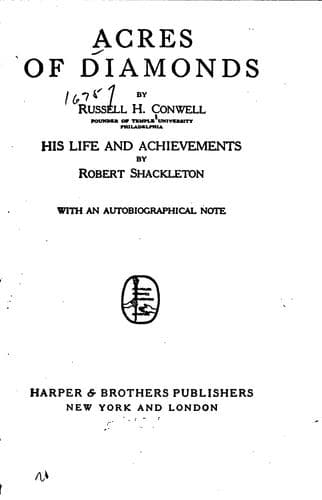
This stirring manifesto shows how to discover everything you need to succeed— where you least expect it.So begins one of the most famous speeches of the twentieth century, a talk that educator and minister Russell H. Conwell delivered before literally thousands of audiences before his death in 1925. In its printed version Acres of Diamonds reached millions of readers around the world. Conwell's great manifesto imparts one extraordinary lesson: All the wealth you could ever dream of, search for, or yearn after—in whatever form you wish for—exists right beneath your own feet. It is a message of determination, unconventional thinking, and positive living that came to influence a generation of motivational literature.The Success Classics edition of Acres of Diamonds also features two rare bonus works: Praying for Money and The Story of "Acres of Diamonds" by journalist Robert Shackleton.
At a later time the sum of ten thousand dollars was importunately
needed. It was due, payment had been promised. It was for some of the
construction work of the Temple University buildings. The last day had
come, and Conwell and the very few who knew of the emergency were in the
depths of gloom. It was too large a sum to ask the church people to make
up, for they were not rich and they had already been giving splendidly,
of their slender means, for the church and then for the university.
There was no rich man to turn to; the men famous for enormous charitable
gifts have never let themselves be interested in any of the work of
Russell Conwell. It would be unkind and gratuitous to suggest that
it has been because their names could not be personally attached, or
because the work is of an unpretentious kind among unpretentious people;
it need merely be said that neither they nor their agents have cared
to aid, except that one of the very richest, whose name is the most
distinguished in the entire world as a giver, did once, in response to
a strong personal application, give thirty-five hundred dollars, this
being the extent of the association of the wealthy with any of the
varied Conwell work.
So when it was absolutely necessary to have ten thousand dollars the
possibilities of money had been exhausted, whether from congregation or
individuals.
Russell Conwell, in spite of his superb optimism, is also a man of deep
depressions, and this is because of the very fire and fervor of his
nature, for always in such a nature there is a balancing. He believes in
success; success must come!--success is in itself almost a religion with
him--success for himself and for all the world who will try for it!
But there are times when he is sad and doubtful over some particular
possibility. And he intensely believes in prayer--faith can move
mountains; but always he believes that it is better not to wait for
the mountains thus to be moved, but to go right out and get to work at
moving them. And once in a while there comes a time when the mountain
looms too threatening, even after the bravest efforts and the deepest
trust. Such a time had come--the ten-thousand-dollar debt was a looming
mountain that he had tried in vain to move. He could still pray, and he
did, but it was one of the times when he could only think that something
had gone wrong.
The dean of the university, who has been closely in touch with all his
work for many years, told me of how, in a discouragement which was the
more notable through contrast with his usual unfailing courage, he left
the executive offices for his home, a couple of blocks away.
Reviews
Reviews
No reviews yet
Be the first to share your thoughts on this work.
Join the Discussion
Join the discussion
Sign in to leave a comment or review.
Sign InorCreate an account