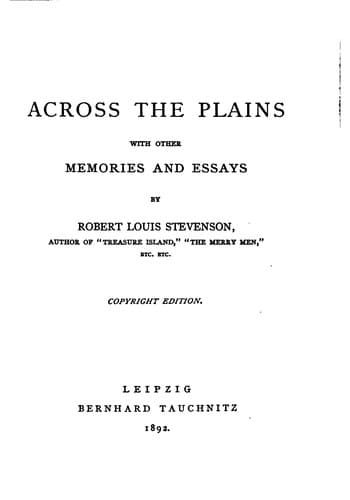
Across the Plains, with Other Memories and EssaysStevenson, Robert Louis
General
Across the Plains, with Other Memories and Essays
Stevenson, Robert Louis
Essays; Monterey (Calif.) -- Description and travel; West (U.S.) -- Description and travel
last a jubilant leap to wakefulness, with the cry, “I have it, that’ll
do!” upon his lips: with such and similar emotions he sits at these
nocturnal dramas, with such outbreaks, like Claudius in the play, he
scatters the performance in the midst. Often enough the waking is a
disappointment: he has been too deep asleep, as I explain the thing;
drowsiness has gained his little people, they have gone stumbling and
maundering through their parts; and the play, to the awakened mind, is
seen to be a tissue of absurdities. And yet how often have these
sleepless Brownies done him honest service, and given him, as he sat idly
taking his pleasure in the boxes, better tales than he could fashion for
himself.
Here is one, exactly as it came to him. It seemed he was the son of a
very rich and wicked man, the owner of broad acres and a most damnable
temper. The dreamer (and that was the son) had lived much abroad, on
purpose to avoid his parent; and when at length he returned to England,
it was to find him married again to a young wife, who was supposed to
suffer cruelly and to loathe her yoke. Because of this marriage (as the
dreamer indistinctly understood) it was desirable for father and son to
have a meeting; and yet both being proud and both angry, neither would
condescend upon a visit. Meet they did accordingly, in a desolate, sandy
country by the sea; and there they quarrelled, and the son, stung by some
intolerable insult, struck down the father dead. No suspicion was
aroused; the dead man was found and buried, and the dreamer succeeded to
the broad estates, and found himself installed under the same roof with
his father’s widow, for whom no provision had been made. These two lived
very much alone, as people may after a bereavement, sat down to table
together, shared the long evenings, and grew daily better friends; until
it seemed to him of a sudden that she was prying about dangerous matters,
that she had conceived a notion of his guilt, that she watched him and
tried him with questions. He drew back from her company as men draw back
from a precipice suddenly discovered; and yet so strong was the
attraction that he would drift again and again into the old intimacy, and
again and again be startled back by some suggestive question or some
inexplicable meaning in her eye. So they lived at cross purposes, a life
full of broken dialogue, challenging glances, and suppressed passion;
until, one day, he saw the woman slipping from the house in a veil,
followed her to the station, followed her in the train to the seaside
country, and out over the sandhills to the very place where the murder
was done. There she began to grope among the bents, he watching her,
flat upon his face; and presently she had something in her hand—I cannot
remember what it was, but it was deadly evidence against the dreamer—and
as she held it up to look at it, perhaps from the shock of the discovery,
her foot slipped, and she hung at some peril on the brink of the tall
Public-domain text, read in full here on John Shaqi.
Reviews
Reviews
No reviews yet
Be the first to share your thoughts on this work.
Elsewhere in the archive
Join the Discussion
Join the discussion
Sign in to leave a comment or review.
Sign InorCreate an account